DUTCH BIBLES – Facsimiles & Download
Already in 1477 a Dutch version of the OT (Delftse Bijbel) was published. Dutch (Low German) initially consisted of several dialects that influenced each other. For this reason, the pre-Lutheran Low German Bibles and the Bugenhagen Bible were initially used in the Netherlands. From 1526 onwards, a translation into the actual Dutch language was made. The Dutch were very good at spreading the gospel of Jesus Christ's produced several excellent translations. The first Bibles were printed in Germany because the Netherlands was under the rule of Catholic Spain for a long time and the production of Dutch printed matter was punishable by death. These old Bibles can be downloaded free of charge on the Internet.
The Dutch have proven themselves to be a very courageous people who love the Word of God. When the Netherlands was occupied by Catholic Spain for a long period of time and Bible prints in the national language were banned, there were still not just a few, but many Dutch people who valued the spread of the Gospel more than their own lives and safety. Several translators and printers were killed by the Catholics, and we are very happy to meet them in the heavenly kingdom of God. Not only is the courage of the Dutch commendable, but also the quality of the Bible translations, because several Bible translations refer to the resurrection of Jesus on a Sabbath morning (see examples). As in the German language, excellent Dutch Bible prints have also been published, which anyone can now download here. The word “Vertaling” means “Translation” in English. The most accurate and best Dutch Bible is the Scripture4All Bijbel 2014 (see Link). Like the German manuscripts, the first German prints, and the Spanish, Swedish, Icelandic, Italian, Slovenian and Czech Bibles, many Dutch Bibles also show the resurrection of the Lord Jesus Christ “on a Sabbath” morning (examples).
Catholic Bibles
Zuid-Nederlandse evangelievertaling (Southern Dutch Gospel Translation) 1300, Rijmbijbel (History Bible) 1332, Luikse diatessaron (Liège Diatessaron) 1275, Hernse Bijbel (Hernse Bible) 1360, Noord-Nederlandse vertaling van het Nieuwe Testament (Northern Dutch Translation of the New Testament) 1390, Brabant (Rooklooster) Gospels 1400, Gospels and reflections from the 15th century, Delftse Bijbel (Delft Bible) 1477, Vorstermanbijbel (Vorsterman Bible) 1528, Leuvense Bijbel (Leuven Bible) 1548, Blankart NT (Cologne Bible) 1548, Professorenbijbel (Professors' Bible) 1894, Petrus Canisiusvertaling (Petrus Canisius Translation) 1929, Willibrordvertaling (Willibrord Translation) 1961.
Protestant Bibles
Protestant Bibles: Liesveltbijbel (Liesvelt Bible) 1625, Biestkensbijbel (Biestkens Bible) 1560, Deux-Aesbijbel (Deux-Aes Bible) 1562, Statenvertaling (States Translation) 1637, Visscherbijbel (Visscher Bible) 1648, Carel Catz NT 1710, Palmbijbel (Palm Bible) 1822, Telosvertaling (Telos Translation) 1877, Leidse Vertaling (Leiden Translation) 1912, NBG 1951, Het Boek (The Book) 1988, Naardense Bijbel (Naarden Bible) 2004, Herziene Statenvertaling (Revised Statenvertaling) 2010, BasisBijbel (Basis Bible) 2013-2016, Bijbel in Gewone Taal (Bible in Everyday Language) 2014.
Ecumenical Bibles
Ecumenical Bibles: Groot Nieuws Bijbel (Great News Bible) 1983, Nieuwe Bijbelvertaling (New Bible Translation) 2004, NBV21 2021
Low German Bibles
Low German Bibles: Dutch and Low German Bibles are very similar. Therefore, it is worthwhile to study the chapters on pre-Lutheran Bibles (vor-lutherische Bibeln, and Low German Bibles (niederdeutsche Bibeln).
There were four Low German Bibles before Luther: [1.-2.] Cologne Bible (Kölner Bibel) 1478 and 1479, [3.] Lübeck Bible (Lübecker Bibel) 1494; [4.] Halberstadt Bible (Halberstädter Bibel) 1520-1522.
The Latin Egmond Gospels 9th century
The Egmond Gospels is a 9th-century illuminated vellum manuscript famous for its depiction of Count Dirk II and Countess Hildegard of 'Holland'. The two had their likenesses added in 975 and, more than 1,000 years later, they are the oldest surviving images of Dutch people. A Gospel Book is a volume containing the four gospels from the Bible, the four accounts written by Jesus' disciples Matthew, Mark, Luke and John of their teacher's life, death and resurrection. The four books are all written in Latin – the language of the Catholic Church for centuries – and are a core part of the New Testament and indeed of Christianity as a whole.
Facsimiles and download:
Historiebijbel - History Bible 12th century
These manuscripts of the Dutch Historical Bible contain books of the Old Testament in which the biblical text alternates with commentaries from the Historia Scholastica (Wikipedia) by the French theologian Peter Comestor (died 1179). Several Dutch editions appeared over several centuries. In the 15th century, the History Bible was one of the most popular books in the northern Netherlands.
The Rijmbijbel by Jacob van Maerlant is a translation/adaptation of the Historia scholastica (dates from 1271) by Pierre le Mangeur, alias Petrus Comestor († 1179), a leading textbook on biblical history (literally, the history of salvation for schoolchildren), which was used at the theological faculty in Paris. This manuscript, preserved in the Meermanno Museum (Hs 10B21), is a copy made approximately 60 years later, in which a different spelling is used than in the original manuscript.
Facsimiles and Download:
1332 Rijmbujbel, info, Wikipedia
1332 Rijmbijbel (Wikisource, Hs 10B21, 1332)
Facsimiles of different versions of the Historiebijbel:
14xx Historiebijbel, overview 'Historienbibel' (ndl.) (Handschriftenzensus)
1431 Historiebijbel, Utrecht (KBR, MS. 9018-19), Link2
1440 Dutch History Bible comments of the Historia Scholastica (British Library, Add MS 15410) Link no more active
Luikse diatessaron - Liège Diatessaron 1275-1300
The Liège Diatessaron (Luikse diatessaron, Diatessaron Leodiense) or the Liège Life of Jesus is a diatessaron, a form of gospel harmony. The manuscript was written between 1275 and 1300 and has been kept in the library of the University of Liège since 1824. The text consists of 245 chapters and is a continuous narrative of the life of Jesus, from his birth to his death, resurrection, and ascension. The text is based on the four canonical gospels and has a chronological order in which the four evangelists alternate as narrators. However, the Bible was not translated accurately and in some parts supports the teachings of the Catholic Church.
Facsimiles:
South Dutch Gospel Translation ca. 1300
The South Dutch Gospel Translation (Zuid-Nederlandse evangelievertaling) is the oldest preserved Middle Dutch prose text. It is also the only translation of the four separate Gospels from before 1300. The other translations from before 1300 describe the life of Jesus in the form of a Gospel harmony. Three complete manuscripts dating from the fourteenth century have been preserved. This has only been found in four 14th-century manuscripts, but probably dates from around the year 1200.
Jacob van Liesvelt printed this translation in four separate parts in 1522.
Facsimiles and Download:
Hernse Bijbel - Herne Bible 1360

The Herne Bible (Hernse Bijbel) was the first nearly complete Bible in a European vernacular. It was created in the second half of the 14th century in the Carthusian monastery of Herne (near Brussels) and is also known by other names: South Netherlands History Bible (Zuid-Nederlandse Historiebijbel), History Bible of 1360, History Bible of 1361 (De Historiebijbel van 1361), Middelnederlandse historiebijbel, First History Bible, Flemish History Bible. It is an influential Middle Dutch translation based on the Vulgate. The translator was a Carthusian monk Petrus Naghel; others refer to the author as “the Bible translator of 1360” ("Bijbelvertaler van 1360"). The text contains the historical books of the Bible and was expanded with various non-biblical stories (based on the 12th-century Latin example of the Historia Scholastica by Petrus Comestor). The Gospels were not translated, but only summarized in a Gospel harmony (Middelnederlandse evangeliënharmonie).
The first part of Petrus Naghel's Bible was completed in 1360. The Gospels were not translated, but only summarized in a Gospel harmony. Notable absentees are the Epistles from the NT and the Revelation of John. The translation was a huge undertaking, estimated to have comprised nearly 5,000 pages or around two million words, and took around 35 years to complete. The manuscript of the Hernse Bible was copied many times, mainly in the Northern Netherlands, as some 45 handwritten copies have survived to this day. This work was one of the most important literary productions of the Middle Ages and prepared the way for later Dutch translations of the Bible, such as the famous Delft Bible of 1477.
Facsimiles and download:
1360 Hernse Bible, info, Wikipedia
1360 Bijbel van 1360, info, Wikipedia
1360 Herne Bible, “the Bible translator of 1360”, info, Wikipedia
The Northern Dutch Translation 1390
The Northern Dutch translation (Noord-Nederlandse vertaling) of the NT was created around 1390. The author is almost certainly Johannes Scutken (died 23 January 1423), a lay brother who lived in the monastery of the Windesheim congregation. It is the most copied Middle Dutch translation of the New Testament. Approximately 160 manuscripts of this translation have been preserved. The oldest manuscript dates from 1391 and contains the New Testament without the Gospels. A manuscript from 1399 contains the complete New Testament. The first printed versions of this translation date from 1477 and 1478. However, manuscripts continued to be copied until the beginning of the sixteenth century. Manuscripts and printed editions thus coexisted for several decades. A total of 46 printed versions of the translation are known to exist. In terms of print run, this translation was the most successful in the late Middle Ages in the Netherlands.
Facsimiles and Download:
Brabant (Rooklooster) Gospels 1400

A rare Gospel from the monastery Brabant (Rooklooster) near Brussels. Petrus Campenhout is assumed to be the bookbinder or author.
It is clear that this gospel book was translated from the Vulgate, because some phrases and some Latin words were adopted, partly because the translators wanted to translate accurately and partly because they could not always find a suitable Dutch word.
There is no specific Dutch word for the day of preparation (Nisan 14), but it is described using the Latin term parasceve (parasceue), which was translated from the ancient Greek equivalent (παρασκευή, paraskeuḗ). Mark 15:42 therefore reads: “parasceue was dat es vore dem sabbatum” (It was the day of preparation, that is, before the Sabbath).
What is special about this manuscript is that the Sabbath does not have its own Dutch name, but is described using the Latin sabbatum (Mk 15,42; Mk 16,1), sabbati (genitive singular; Mt 28,1; Mk 16,9) or sabbatorum (genitive plural; Mk 16:2, Jn 20:19) or the pagan saterdach or saterdaghe (=Saturday; Lk 23:54,56, Lk 24:1; see image on the right).
Facsimiles and Download:
Gospels and reflections from the 15th century

One of the greatest treasures of Dutch Bibles is this very old and very rare manuscript, which has been well translated from Latin (Vulgate) into middle-Dutch (Staatsbibliothek Berlin, Ms. germ. fol. 90). It is not a printed Bible, but a handwritten one.
Title: “Gospels and reflections” (German: Evangelien und Betrachtungen)
Facsimiles and Download:
14xx Gospels and reflections, (Staatsbibliothek Berlin, Ms. germ. fol. 90)
Other Gospel Books (Evangelistar):
The above source is a complete Gospel book, but several excerpts (Evangelistar) and short summaries of the Bible have been published in Dutch. Here are a few examples:
1488 Evangelistar: Delft Bible New Testament Portions (Archive)
1516 Short
Bible, Antwerpen, Gheprent bi Claes de Graue, “De Bibel int corte ghetranslateert. Wten laine ende walsche metten figueren” = “The Bible translated into short form. With figures and
illustrations” (Library of Congress)
1712 Epistelen, “Epistelen ende Evangelien met de Gebeden der H. Hercke: Die gelesen worden inde H. Misse gedurende het geheet Jaer Van nieuws
overdien ende verbetert” (BDH)
Delftse Bijbel, Delft Bible 1477 (only OT)

The first printed Bible was the Gutenberg Bible in 1455, which published the Latin text of the Vulgate. The first Bible in a national language was the German Mentelin Bible of 1466. The Delft Bible (Delftse Bijbel, Wikipedia) is the first printed book in Dutch (Low German; at that time, it was called “Bible in duytsche” = Bible in German). The first printed book in Dutch was therefore a Bible. The typesetting of the book was completed on January 10, 1477, and the work was published in Delft by Jacob Jacobszoon van der Meer and Mauricius Yemantszoon van Middelborch. The Delft Bible was based on the South Dutch Hernse History Bible, which was translated around 1360 by the Bible translator of 1360, alias the Carthusian monk Petrus Naghel, prior of the Carthusian monastery of Herne (1366-1369) in the Pajottenland. The translator based his work on the Vulgate but also, like Maerlant, on the Historia Scholastica. The Delft Bible does not contain the complete Bible, but only the Old Testament, without the Psalms. It is bound in two volumes and has no title or title page. The incipit of part 1 reads: ‘Hier beghint dat prologus vander biblen des ouersetters te duytsche vten latine’ (Here begins the prologue of the Bible of the translator from German to Latin).
Title: “De Bible in Duytsche is de eerst gedrukte Nederlandstalige bijbel in Nederland. Het werd gedrukt op 10 januari 1477 door Jacob Jacobszoon van der Meer en Mauricius Yemantszoon van Middelborch. De bijbelvertaling omvat het Oude Testament zonder de Psalmen. - Ook bekend onder de titel: Bible. overset te Duijtsche uten Latine.”
Facsimiles and download:
1477 Delft Bible, info, Wikipedia
1477 Delft Bible, Delft, facsimile and online text (bijbelsdigitaal), Link2
Dutch Old Testament of 1516
The Bible of 1518 is an enlargement and revision of the version printed at Antwerp in 1513 and 1516, which was limited to portions of the Old Testament. Includes additional Old Testament books, Acts, and Revelation. The printer issued 2 editions under the same title but in different dialects.
Title: “De Bibel int corte ghetranslateert. Wten laine ende walsche metten figueren.“
Translated: “The Bible translated into short form. With figures and illustrations.“
Printed in Antwerpen (Belgium) by Claes de Grave
Facsimiles:
1516 Dutch OT, Antwerpen: Claes de Grave (Library of Congress. Lessing J. Rosenwald collection, 1133), Link2, Link3
1518 Dutch OT, Antwerpen: Claes de Grave (Library of Congress. Lessing J. Rosenwald collection, 1143), Link2
Dutch Gospels and NT by Pietersoen 1523-1524

Dutch Gospels printed and published by Doen Pietersoen (Doen Pieterz) in Amsterdam. The translator is unknown (Liesvelt?), but this text was widely adopted in the Liesveld Bible of 1526. In addition to the Gospels, the Acts of the Apostles and Revelation were also translated and are included in the second volume.
Title 1523: “DIE EVANgelien ons heeren Jesu Christi, inder duytscher sprake, getranslateert. Die welcke sinte Matheus sinte Marcus, sinte Lucas, ende sint Jan bescreven hebben. Ende voor elck Capittel een corte bedudenisse, op dat men weten mach hoe dat elck kersten mensche sculdich is die Evangelien Cristi te lesen, ende dye in zijn herte te draghen, boven alle andere leeringen ende scrifturen. Ende daer in vrijlijck ende ghetrouwelick te leeven ende te sterven. Neerstelick gecorrigeert.”
Translated: “The Gospels of our Lord Jesus Christ, translated into German. Which were written by Saint Matthew, Saint Mark, Saint Luke, and Saint John. And before each chapter a short explanation, so that one may know how every Christian person ought to read the Gospels of Christ, and carry them in his heart, above all other teachings and scriptures. And to live and die freely and faithfully therein. Carefully corrected.”
Facsimiles:
1523 Pietersoen Gospels, Vol.1 (Google Books), Link2
1523 Pietersoen Gospels, Vol.2, Acts, Revelation (Google Books)
1523 Pietersoen Gospels (Bibliasacra.nl, 1524.Gosp.dut.DP.a)
In 1523, a complete New Testament was also published:

The Reprint from Cologne 1525
In 1525, the New Testament was reprinted in Cologne (Coellen, Germany) by Hieronem Fuchs. Only minor changes were made to the spelling.
Title 1525: “Dat niwe testament ons heeren Jesu Christi, met alder neersticheyt ouersien ende verduijtst. Een vermaninghe offt onderwijsinghe, om allen Christen menschen, met grooter neersticheyt dat Euangelium te lesen. Evangelium ... Noch salmen hier achter in desen boeck finden sommighe epistolen, genomen wt den ouden testamente, die menn in der missen leest, nw nieuwelick dar by gheset... Gheprint tot Collen, duir Hieronem Fuchs. Anno M.CCCCC.XXV. [1525]”
Translated: “The New Testament of our Lord Jesus Christ, with all humility reviewed and explained. An exhortation or instruction to all Christian people to read the Gospel with greater humility. Gospel ... Also here in this book you will find some epistles taken from the Old Testament, which are read during Mass, now newly added... Printed in Cologne, by Hieronem Fuchs. Anno M.CCCCC.XXV. [1525]”
Facsimiles:
Liesvelt Bijbel 1526
Jacob van Liesvelt (Liesveldt, *1490, †1545; Wikipedia) was a translator and printer from Antwerp who produced the first complete translation of the Bible into Dutch in 1526. This resulted in a printed Dutch full Bible, even before the Zurich Bible was published in 1530 as the first German-language version and the first complete Luther Bible in 1534. Liesvelt translated the NT from Luther's 1522 edition, but he also printed numerous Catholic writings that were directed against the Reformation. After Luther published his first complete Bible in 1534, Liesvelt undertook a revision of the Dutch Bible and printed the new edition in 1535 (text in double columns of 64 lines). Since the Netherlands was under the rule of Catholic Spain, all Protestant Bible translations were banned. When Liesvelt nevertheless printed a new edition in 1542, he was classified as a heretic and was beheaded on November 28, 1545. In addition, a terrible law was passed: Whoever had a Protestant Bible in his house, all his possessions were sold. The proceeds were then divided between the traitor and the state. Thousands of Protestants therefore had to leave the Netherlands and fled to tolerant Germany (Emden) or other states.
Van Liesvelt published the first whole Bible in Dutch in 1526 with subsequent editions in 1532, 1534, 1535 and the 6th and last edition coming out in 1542. Reprints appeared until the second quarter of the 17th century.


Title 1526: “Dat oude ende dat nieuwe testament – Gheprint ende gheeyndt in dye vermaerde coopstadt van Antwerpen. Inden Jare ons HEEREN M.CCCCC. ende. xxvi. den.. vi. dach van September, By my Jacob van Liesveldt wonende tot Antwerpen op dye Cammerpoort Brugghe Is God met ons, Wie mach ons letten Fortitudo mea Deus.”
Translated 1526: “The Old and New Testaments – Printed and bound in the renowned city of Antwerp. In the year of our Lord M.CCCCC. and xxvi. on the sixth day of September, by Jacob van Liesveldt, residing in Antwerp at the Cammerpoort Brugghe. God is with us, who can stop us? Fortitudo mea Deus.”
Title 1535: “Den Bibel, met grooter neersticheyt gecorrigeert : eñ op die canten gheset den ouderdom der werelt : ende hoe lange die gheschiedenissen ende historien der Bibelen elck int zijn voor Christus gheboorte gheweest zijn : ende daer bi vergadert wt fasciculus temporum, ende wt dye cronike vă alder werelt, die principael historiē der machtiger heydenscher conincrijckẽ, daer die heylige scrift oock dickwils af vermaent, tot een claerder verstant der Bibelscher historien : ende oock een onderscheyt der tijden te hebben.”

Title 1542: “Den Bybel met groter neersticheyt ghecorrigeert, ende op dye canten ghesedt den ouderdom der werelt, ende hoe langhe die gheschiedenissen ende historien der Bybelen, elc int sijne voor Christus gheboorte gheweest sijn, ende daer bi vergadert wt Fasciculus temporum, ende wt dye Cronike van alder werelt, die principael historien der machtiger Heydenscher Conincrijcken, daer die heylige scrift oock dicwils af vermaent, Nv ooc laetstwerf met groter neersticheyt ghecorrigeert, wt die alder oudtste ende geapprobeertste Copien, die welcke ghedruct sijn Cum Gratia et Priuilegio. Ende dat inhout bouen elcken capittel des seluen Capittels, soo wel des ouden Testaments als des nieuwen Testaments Met noch sommighe schoone verclaringhen op dye canten, dye op dander noyt gheweest en sijn. En laet dit boeck van deser wet wt uwen monde niet comen, mer peynst daer om dach ende nacht. Iosue. I. Ist dat yemant tot v coemt, ende dese leeringhe niet mede en brengt, dien en nemet in uwen huyse niet, en groet hem ooc niet ij.Iohan. i. Mar. vi. Gaet in alle die werelt, ende predict dat Euangelium allen creatueren. Die gheboden des HEREN sijn suyuer, ende si verlichten die ooghen. Psal. xviij.”
Translated 1542: “The Bible corrected with greater accuracy, and on those pages written the age of the world, and how long the events and histories of the Bible each of which occurred before the birth of Christ, and compiled from Fasciculus temporum, and from the Chronicle of the World, the principal histories of the mighty pagan kingdoms, which are also often mentioned in the Holy Scriptures, Now also recently corrected with greater accuracy, from the oldest and most approved copies, which are printed Cum Gratia et Priuilegio. And that content above each chapter of the same chapter, both of the Old Testament and of the New Testament, with some beautiful explanations on those points, which have never been and are not on others. And let this book of this law not come out of your mouth, but ponder it day and night. Joshua I. If anyone comes to you and does not bring this teaching, do not take him into your house, nor greet him. John I. Mark VI. Go into all the world and preach the Gospel to all creatures. The commandments of the LORD are pure, and they enlighten the eyes. Psalm 18.”
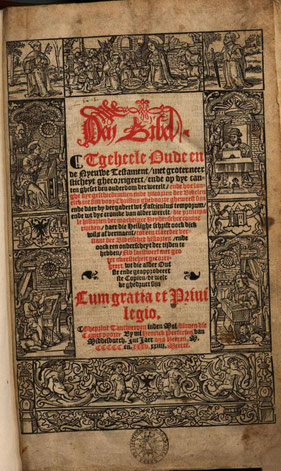
Heynrick Peetersen van Middelburch printed 1535 a Liesvelt Bible in Antwerp with a title page similar to the one used for the Vorsterman Bible. It is not the text of the Vorsterman Bible, as the section in the resurrection chapter in particular shows, that is especially well suited for identifying a Bible translation, because this is where the Bibles differ most in content.
Title 1535 (van Middelburch): “Den Bibel: tgeheele Oude ende Nyeuwe Testament, met groter neersticheyt ghecorrigeert...”
Title NT 1538: “Dat nieuwe testament ons Heeren Iesu Christi.”

Facsimiles and download:
1526 Liesfelt Bible, info, Wikipedia
1526 Liesfelt Bible, Antwerp (bibliasacra,nl, 1526.B.dut.JvL.a)
1535 Liesveldt Bible, Antwerp (Archive), Link2, Link3
1535 Liesvelt Bible, Antwerp (Hathitrust)
1535 Liesvelt Bible, Antwerp (bibliasacra.nl, 1535.B.dut.JvL.a)
1535 Liesvelt Bible, Tantwerpen: by mi Heynrick Peetersen van Middelburch (Google Books)
1538 Liesvelt NT, printed by Mattheus Cromme (Google Books), Link-2
1542 Liesvelt Bible, Antwerp, facsimile and digital text (Bijbelsdigital), Link2
1542 Liesvelt Bible, digital text (dbnl)
1560 Liesvelt Bible, printed by die weduwe van Jacob van Liesveldt (Google Books)
Vorsterman Bijbel 1528/1531

Willem (Wilhelm) Vorsterman (born unknown, died 1543; Wikipedia) published the first Catholic Dutch Bible in Antwerp, the Vorstermanbijbel (Wikipedia). It was officially approved by the inquisitor Nicolaas Coppijn and sold widely as a counterpoint to the Protestant Liesvelt Bible. Vorsterman's desire to serve a diverse audience is evident from his printing of both the papal bull against Luther in 1520 and six Danish translations of Luther in 1531. According to official sources, it was translated from the Vulgate, but in fact the text corresponded mainly to the Liesvelt Bible. It was therefore a translation that was accepted by both Catholics and Protestants. The translation of the OT bears great similarities to Van Liesvelt's Bible from 1526. However, in certain passages where the Vulgate differed from the Liesvelt text, a translation from the Vulgate was given, while the Liesvelt text was written in the margin. The NT in the first edition 1528 is based on Luther's and Liesvelt's text, while the NT in the 1531 edition is based on Erasmus' text. With 238 illustrations by Jan Swart and Lucas van Leyden, it was one of the most beautiful Bibles of its time. Seven editions were published. However, in 1545, the Council of Trent decided that the only true and authorized Bible was the Latin Vulgate. As a result, the Liesvelt Bible and the Vorsterman Bible were added to the list of banned books. This shows once again that most Christians today are unaware of what a blessing it is to be able to own a Bible without suffering persecution. But who reads it and remembers what is written in it?
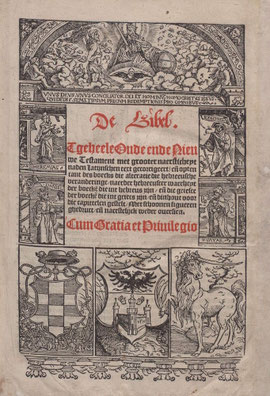
Half of Vorstermans production consists of works in Dutch. But he also produced books in French, Spanish, English, Latin and Danish, including six translations of Luther. The first edition of the Vorsterman Bible from 1528 was presented as a new authorized Catholic Bible translation. However, this edition actually contained quite a bit of previously published Middle Dutch material from the pre-Reformation era, as well as much from Reformation circles. In later editions, essential Reformation passages had already disappeared and it was considerably more in line with the text of the Vulgate. Editions: 1528, 1530/1531, 1532, 1533, 1534 und 1542/1543.
Title 1528/1531: “De Bibel. Tgeheele Oude ende Nieuwe Testament met grooter naersticheyt naden Latijnschen text gecorrigeert, ende opten cant des boecks die alteratie die hebreeusche veranderinge, naerder hebreeuscer waerheyt der boecken die int hebreus zijn, ende die griecse der boecken die int griecs zijn, ende dinhout voor die capittelen gestelt, Met schoonen figueren ghedruct, ende naerstelijck weder ouersien. Cum Gratia et Priuilegio.”
Translated: “The Bible; The entire Old and New Testaments, carefully corrected according to the Latin text / and on the cantus of the book, the alteration, the Hebrew changes / closer to the Hebrew truth of the books that are in Hebrew / and the Greek of the books that are in Greek / and with illustrations placed before the chapters / Printed with beautiful figures and carefully reviewed. Cum Gratia et Privilegio.”
Note: In Dutch libraries, the Vorsterman Bible is often dated 1528/1531. However, this is an error, because the 1528 edition was translated from Luther's German text and the 1531 edition from the Latin Vulgate.
The chapter on the Resurrection in the New Testament is a particularly good place to determine which edition is being referred to, because Matthew 28:1 contains the word “holiday” (vierdagen), which can only come from Luther's New Testament of 1522.
The Catholics certainly did not want it to become known that their Bible had been translated from a Protestant Luther Bible, of all things.


Facsimiles and download:
1528 Vorsterman Bible, info, Wikipedia
1528 Vorsterman Bijbel, Antwerpen (Google Books)
1528 Vorsterman Bijbel, Antwerpen, Info text (biblianeerlandica)
1528/1531 Vorsterman Bible, digital text (dbnl), Link2 Images
1531 Vorsterman Bible, facsimile & online text (bijbelsdigitaal), Link-2
1532 Vorsterman Bible, Antwerpen (BSB, 2 Th B VIII.34 1), Link-2
1532 Vorsterman Bible, Antwerpen (Google Books), Link-2- from BSB
1533 Vorsterman Bible, Antwerpen (BSB, 4 B.rel. 50 c), Link-2
1533 Vorsterman Bible, Antwerpen (Google Books - from BSB)
1533-1534 Vorsterman Bible, (ÖNB, 2.Q.16.(Vol.1) ALT PRUNK), Link-2
1533-1534 Vorsterman Bible, Antwerpen (Google Books - from ÖNB)
1533 Vorsterman Bible, Auction (invaluable)
1541 Vorsterman Bible, (Google Books)
Leuvense Bijbel - Leuven Bible 1548
The widely printed Protestant Bibles were a major thorn in the side of the Catholic Church. It was no longer possible for the Church to burn all of these widely distributed Bibles. Therefore, the Catholic Church decided to publish its own new translation. In 1548, Nicolaas van Winghe (*1495, †1552; Wikipedia) translated an official Catholic Bible translation in Leuven (Löwen, hence the name Leuvense Bijbel), which was intended to replace the Protestant Liesvelt Bible. It was printed by Bartholomeus van Grave and refers to the “Holy Roman Church” in its title. The Vulgate of 1592 served as the basis for the translation.
The Leuven Bible was reprinted in Cologne in 1565 by Birckman Publishers as a corrected and improved version. The text differs only slightly from the earlier editions.


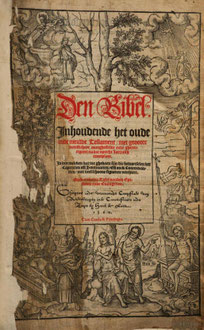

Title 1548: “Den gheheelen Bybel, Inhoudende het oude ende uieuwe Testament, Met grooter naersticheyt ende arbeyt nv corts in duytsche van nyews ouerghestelt wt den Latijnschen ouden text, die ouer duysent iaren in die heylighe Roomsche kersten kercke ghehouden is gheweest, onlancs te Loeuen by sekeren gheleerde wt beuel der Keyserlijcker Maiesteyt ghecorrigeert ende aldaer Ghedruct. In sole posuit tabernaculu Tuus. Gedruct in die vermaerde Uniuersiteyt ende stadt van Loeuen, by my Bartholomeus van Graue, ghesworen boeckdrucker. Int iaer ons Heeren. M.CCCCC [1500]. ende XLVIII [48]. In die maent Sept. Cum Gratia et Priuilegio.”
Translated: “The entire Bible, containing the Old and New Testaments, With great diligence and labor, recently translated into German from the Latin text, which has been preserved for over a thousand years in the Holy Roman Catholic Church, recently corrected in Leuven by certain scholars at the behest of His Imperial Majesty, and printed there. In sole posuit tabernaculu Tuus. Printed in the renowned University and city of Leuven, by me Bartholomeus van Graue, sworn book printer. In the year of our Lord M.CCCCC [1500] and XLVIII [48]. In the month of September. Cum Gratia et Priuilegio.”
Title 1556 (Laet): “Den Bibel: inhoudende het oude ende nieuwe Testament ... In den welcken dat toe ghedaen sijn die beduytselen der Capittelen oft Sammarien Ende oock Concordantien met veel schoone figueren verciert ; Oock mede die Tafel vanden Epistelen ende Evangelien”


Title 1565 (Birckman): “Den Bibel Inhoudende het oude ende nieuwe Testament, met grooter meersticheyt ouerghesteldt ende ghecorrigeert na dat oprecht Latijnsch exemplaer : Jn den welcken dat toegedaen sijn die Sommarien ... der Capittelen ende Concordantien ...”
Title 1566 (Nuyts): “Den Bibel: inhoudende het Oudt ende Niev Testament; Met cort beduytsel voor elck Capittel, ende ghetal aen de canten, tot elcker bevvijsinghe der concordancien, Tantwerpen, By Philips Nuyts, inde twee Oevaers. M.D.LXVI.”
Title 1566 (Birckman): “Den Bibel, inhoudende het Oude ende Nieuwe Testament, met grooter neersticheyt overghesteldt ende ghecorrigeert na dat oprecht Latijnsch exemplaer. In den welcken dat toegedaen zijn die sommariën oft beduytselen der Capittelen ende Concordantien. Oock mede die Tafel van den Epistelen ende Evangelien. Met schoone nieuwen figueren verchiert...”
Translated 1566 (Birckman): “The Bible containing the Old and New Testaments, translated and corrected with great care according to the authentic Latin edition. In which are included the summaries or explanations of the chapters and concordances. Also the table of the Epistles and Gospels. Decorated with beautiful new figures...”
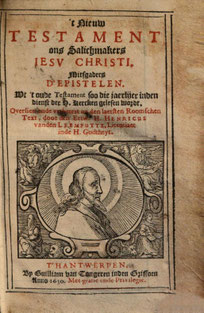
Title 1630 (Leemputte): 't Nieuw Testament ons Salichmakers Jesu Christi. Mitsgaders d'Epistelen. Wt 't oude Testament soo die jaerlijer inden dienst der H. Kercken gelesen wordt. Oversien ende verbetert na den laetsten Roomschen Text, door den Eerw. H. Henricus vanden Leemputte, Licentiaet inde H. Godheyt. T'HANTWERPEN...
Facsimiles:
1548 Leuvense Bible, info, Wikipedia
1548 Leuvense Bible, scan and digital text (bijbelsdigitaal.nl), Link-2
1548 Leuvense Bible, digital text (dbnl)
1548 Leuvense Bible, Bartholomeus van Grave (Google Books)
1556 Leuvense Bible, Andtwerpen: Laet (BSB, Res/4 B.rel. 50 k), Google Books
1556 Leuvense Bible, Andtwerpen: Laet (Google Books)
1560 Leuvense Bible, Antwerpen: Laet (Google Books)
1564 Leuvense Bible, Antwerpen: Laet (Google Books)
1565 Leuvense Bible, Cuelen: Birckman (BSB, Res/4 B.rel. 50 z, VD16: ZV 1548), Link-2, Link-3
1565 Leuvense Bible, Cuelen: Birckman (Google Books from BSB), Link-2
1565 Leuvense Bible, Cuelen: Birckman, Nicolaes van Winghe (Google Books)
1565 Leuvense Bible, Antwerpen: Laet (BSB, Res/4 B.rel. 50 l), Google Books, Google Books-2
1566 Leuvense Bible, Cuelen: door die Erffgenamen van Arnold Birckmann, Nicolaus von Winghe (Google Books), GB-2
1566 Leuvense Bible, Tantwerpen: Nuyts (BSB, 4 B.rel. 9 s), Google Books
1566 Leuvense Bible, Tantwerpen: Nuyts (Archive)
1566 Leuvense Bible, Tantwerpen: Nuyts, Nicolaus von Winghe (Google Books), Link-2
1566 Leuvense NT, Tantwerpen: by Ameet Tavernier (GB)
1566 Leuvense NT, Tantwerpen: P. van Keerberghen (GB)
1567 Leuvense NT, Antwerpen: by my Jan Gymnick (GB)
1571 Leuvense NT, Tantwerpen: by Christoffel Plantyn (GB), Link-2, Link-3, Link-4
1572 Leuvense NT, Tantwerpen: by my Matheus van Roye (GB)
1577 Leuvense NT, Tantwerpen: by Christoffel Plantijn (GB)
1601 Leuvense NT, Tantwerpen: by Jan van Keerberghen (GB)
1604 Leuvense NT, Tantwerpen: by Christoffel Plantijn (GB), Link-2
1610 Leuvense NT, Tantwerpen: by Ian van Keerbergen (GB)
1615 Leuvense NT, Thantwerpen: by Jan van Keerberghen (GB)
1630 Leuvense NT, t'Antwerpen, Leemputte: by Guilliam van Tongeren (GB)
1694 Leuvense NT, t'Antwerpen, Leemputte: by Johannes van Soest (GB)
1704 Leuvense NT, t'Antwerpen, Leemputte: by Joannes van Soest (GB), Link-2, Link-3
1725 Leuvense NT, t'Antwerpen, Leemputte: de Erve van de Wed: C. Stichters (GB)


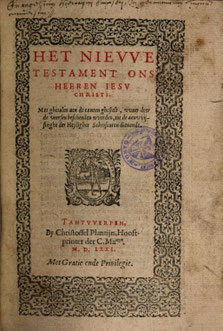
Title 1571: “Het Nievvve Testament ons Heeren Iesv Christi. Met ghetalen aen de canten gestelt, vvaer door de veersen bescheeden vvorden tot de aenvvijsinge der Heyliger Schriftueren dienende.”
Translated 1571: “The New Testament of our Lord Jesus Christ. With numbers placed at the margins, where the verses are arranged to serve as an introduction to the Holy Scriptures.”




Blankart Bible - Cologne Bible 1548
It was a revision of the early version from the Vulgate, which was first published in 1477: it was compiled by Alexander Blankart, a Carmelite, and others under the supervision of the authorities of the University of Cologne. The Cologne painter Anton Woensam collaborated on this work. Printed in Cologne (Germany) by Jaspar van Gennep, “met Keyserlyker Genade ende Privilegien” (with imperial grace and privileges). Blanckart's translation was commissioned by Georg van Egmond, Bishop of Utrecht. It was later condemned by the Faculty of Theology at Leuven because in the same year, the official Catholic Leuven Bible (Leuvense Bijbel) was published in 1548.. So there was only one edition of this Bible.
Title 1548: Die Bibel, wederom met grooter nersticheit ouersien ende gecorrigeert, meer dan in seß hondert plaetzen, ende Collacioneert met den ouden Latinschen, ongefalßten Biblien. Duer B. Alexander Blanckart, Carmelit. Gerprent roe Coelen by Jaspar van Gennep, met Keyserlyker Genade ende Priuilegien, Int Jaer ons Herren Jesu Christi, MDXLVIII [1548].
Translated: The Bible, once again carefully reviewed and corrected in more than six hundred places, and collated with the old Latin, unadul-terated Bible. By B. Alexander Blanckart, Carmelite. Printed in Coelen by Jaspar van Gennep, with Imperial Grace and Privilege, in the Year of Our Lord Jesus Christ, MDXLVIII [1548].


Facsimiles:
1548 Blanckart Bible, Vol.1, OT, Coeln (WLB, Bb niederländ.154801)
1548 Blanckart Bible, Vol.2, NT, Coeln (WLB, Bb niederländ.154801), Leo-BW
1548 Blanckart Bible, Vol. 1, Coelen: by Jaspar van Gennep (Google Books), Google Books-2
Jan Utenhove NT 1556

Jan van Utenhove (*1516; †1566; Wikipedia) became known as the translator of the Psalms and the New Testament into Dutch. It was printed in Emden (Germany by Gellius Ctematicus (= Gillis van der Erven). The complete edition of his translation of the Psalms was not published until after Utenhove's death in 1566 by the London-based Dutch preacher Godfried (Govaert) van Wingen (Godefridus Wingius).
The Reformed community wanted a Bible that was based as closely as possible on the original Hebrew and Greek texts. During his stay in Emden, Utenhove produced a translation of the NT, which was published in 1556. Utenhove translated the Greek as literally as possible. He aspired “that one may easily trace [trace] what the aforementioned Greek text contains or does not contain.” The Dutch of the translation was very artificial and incomprehensible to many. This translation hardly sold at all and resulted in considerable losses for the financiers and the publisher Gilles van der Erven. Van der Erven then conceived the plan to publish a complete Bible. Utenhove's translation was largely revised by Johannes Dyrkinus, and this revised translation of the New Testament became part of the Deux-Aes Bible, which was published in 1562.
Title 1556: HET NIEVvve Testament, dat is, Het nieuwe Uerbond onzes Heeren Iesu Christi, Na der Grieckscher waerheyt in Nederlandsche sprake grondlick end trauwlick ouerghezett... Gedruckt te Embden by Gellium Ctematium. An. 1556.
Translated: The New Testament, that is, The New Covenant of our Lord Jesus Christ, Translated from the Greek truth into the Dutch language, thoroughly and faithfully... Printed in Embden by Gellium Ctematium. In the year 1556.
Facsimiles:
1556 Utenhove NT, Embden: by Gellium Ctematium (dbnl)
1557 Utenhove 25 Psalms (dbnl)
1558 Utenhove 26 Psalms (dbnl)
1561 Utenhove 100 Psalms (dbnl)
1566 Utenhove Psalms (Utrecht University, Utenhove oct 494 (Rariora))
Mierdman Bijbel 1558
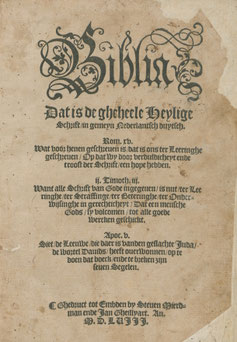
Steven Mierdman (Steuen Mierdman, Stephen Mierdman, Mierdmann, *1510, †1559, Wikipedia) was a printer from Antwerp who first moved to London and printed numerous books in various languages between 1549 and 1553. After the Catholic Queen Mary (Bloody Mary; *1516; †1558; Wikipedia) came to power and had Protestants executed, he fled to Emden (Germany), where he printed a Dutch version of the Bible with the publisher Jan Gheillyart. This Bible was not printed in England, as some sources claim, but in Emden (Embden), as stated on the title page. It is one of the earliest complete Dutch translations of the Holy Scriptures and was produced by an unknown translator who fled Catholic persecution. The translation resembles Luther's Bible text and was written in “common Dutch,” meaning that it was intended to be understandable to a broad population. The Greek source text has been reproduced correctly.
Title 1558: “Biblia Dat is de gheheele Heylige Schrift, in gemeyn Nederlantsch duytsch... Ghedruct tot Embden by Steuen Mierdman ende Jan Ghellyart. An. MDLVIII [1558]”
Translated: “The Bible, that is, the entire Holy Scripture, in common Dutch... Printed in Embden by Steven Mierdman and Jan Ghellyart. Anno MDLVIII [1558]”
Facsimiles:
1558 Mierdman Bible, Emden (Uni Halle, VD16 B 2845)
1558 Mierdman Bible, Emden (Post Reformation Digital Library)
Jacobszoon NT 1558
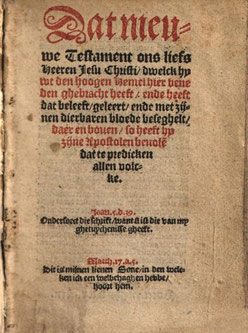
In the diaspora, the Mennonites were apparently the first to resume Bible production after a break of many years. Starting in the 1550s, the Mennonite printer Mattheus Jacobszoon together with Lenaert der Kinderen published a New Testament in Emden, Germany. In it, the text of the 1526 Liesvelt Bible was revised based on the source text and “cleansed” of Lutheran elements and adaptations to the Vulgate. There is one special feature: The apocryphal Epistle to the Laodiceans is printed after the Apocalypse and has the note “This Epistle to the Laodiceans is found in the oldest Bible, printed in Worms. L.D.K.” (Dese Epistel aen de Laodicensen is gheuonden in de alderouste Bibel, die te Worms ghedruckt is. L.D.K.”).
Title 1558 and 1559: “Dat nieuwe Testament ons liefs Heeren Iesu Christi, dwelck hy wt den hoogen Hemel hier beneden ghebracht heeft, ende heeft, ende heeft dat beleeft, geleert, en̄ met sonen dierbaren bloede beseghelt, daer en bouen, so heeft hy zijne Apostolen beuolen dat te predikē allē volcke.” (Ghedruct en verbetert nade copye van Mattheus Iacobszoon)
Translated: “The New Testament of our dear Lord Jesus Christ, which he brought down from heaven above, and has lived, taught, and sealed with his precious blood, there and above, so he commanded his Apostles to preach it to all people.” (Printed and improved according to the copy of Mattheus Iacobszoon).

Facsimiles:
1558 Jacobszoon NT, (British Library, Shelfmark: General Reference Collection DRT Digital Store 3041.a.12.) - after login


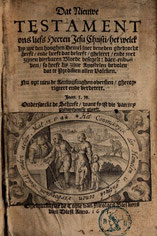


From around 1563 onwards, numerous reprints of this text with the mention of Nicholas Biestgens' name, although the text was not identical to the complete Biestkens Bible of 1560. Instead, it was emphasized that this was the text of the “old exemplar by Nicolaes Biestgens” (oude exemplaer van Nicolaes Biestkens). The place of printing was often not specified.
Title NT 1563: “Dat nieuwe Testament ons liefs Heeren Jesu Christi ... gedruckt na de Copie van Nicolaes Biestkens, 1563” - Translated: “The New Testament of our dear Lord Jesus Christ ... printed according to the copy by Nicolaes Biestkens, 1563”
Title 1614: “Dat Nieuwe Testament ons Heeren Jesu Christi ... Naer 'toude ex. van Nicolaes Biestkens”
Title 1602: “Dat Nieuwe Testament ons liefs Heeren Iesu Christi. Gedruct naer het oude exemplaer van Nicolaes Biestkens”


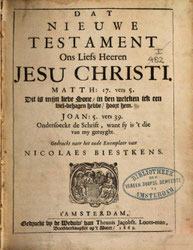


1563 Biestkens NT, Wilhelm Geylliaert (GB), Link-2, Link-3
1602 Biestkens NT, printed in Haerlem (Google Books)
1605 Biestkens NT, H. Lodowinsz. van Haestens (GB)
1614 Biestkens NT, printed by David Wachtendonck (Gogle Books)
1623 Biestkens NT, voor Zacherias Cornelisz (GB)
1634 Biestkens NT, Hendrick Laurentsz (GB), Link-2
1639 Biestkens NT, voor Pieter en Jan Zacharias (GB), Link-2
1662 Biestkens NT, Leeuwarden: printed by Sydtse Rinnerts (GB), Link-2
1669 Biestkens NT, printed by de Weduw' van Theunis Jacobsz. Loots-man (Google Books)
1681 Biestkens NT, Leeuwarden: voor Hendrik Rintjens (Google Books)
Biestkens Bijbel 1560

The text of the Liesveldt Bible was inaccurate in some places. Linguistic improvements were not long in coming. In 1560 (OT 1558) a new complete Bible was printed by Nicholas Biestkens van Diest (*1570, †1623), the Biestkensvertaling. It was the first Dutch Bible to include a complete verse count. The translation is based on a Bible edition published in Emden in 1558, the Latin text (Vulgate) and the Luther Bible (printed in Magdeburg in 1554). The first edition is still closely linked to Luther's text, but the many New Testaments that appeared afterwards were translated from the original Greek text and Vulgate. The place of printing is not indicated on the title page. Initially, it was assumed that it was produced in Emden (East Frisia), but more recent research suggests that it may also have been produced in Groessen, a village near Zevenaar (Northern Netherlands). As the letters were small, less paper had to be used. This made the Bible significantly cheaper than others before it. The Biestkens Bible was used by Mennonites and Baptists for a long period of time. Many editions were published until the eighteenth century. Among Lutherans, this translation was replaced in 1648 by the new Lutheran translation by Adolph Visscher, who edited and modified the Biestkens Bible. The last Biestkens Bible was printed in 1721. It was a very accurate translation, stating that Jesus rose on a Sabbath morning (see info).
Between 1560 and 1723, around a hundred different editions of Biestkens' translation were published, mostly at Amsterdam, but also at Leeuwarden and Harlingen. The last complete edition of the Bible appeared in 1721, published by Kornelis van der Sys in Amsterdam.
Title 1560: “Den Bibel, Inhoudende dat Oude ende Nieuwe Testament. Rom. 15.a.4. Wat voor henen gheschreuen is, dat is ons ter Leeringhe gheschreuen, Op dat wy door verduldicheyt ende troost der Schrift, een hope hebben. Apoc. 5.a.5. Siet, de Leeuwe, die daer is vanden gheslachte Iuda, de Wortel Dauids, heeft ouerwonnen, op te doen dat Boeck ende te breken zijn seuen Seghelen. Ghedruct by my Nicolaes Biestkens van Diest. Int Iaer ons Heeren M. CCCCC. LX.”
Translated 1560: “The Bible, containing the Old and New Testaments. Rom. 15:4. What was written before was written for our education, so that through endurance and the comfort of the Scriptures we might have hope. Apoc. 5.a.5. Behold, the Lion of the tribe of Judah, the Root of David, has prevailed to open the book and to break its seven seals. Printed by me, Nicolaes Biestkens of Diest. In the year of our Lord M. CCCCC. LX.”
Additional note: The year indicated on the title page is MCCCCCLX (i.e. 1560) and not MCCCCCIX (1509), as is incorrectly stated in some sources.
Facsimiles and download:
1560 Biestkens Bible, info, Wikipedia
1560 Biestkens Bible, scans and digital text (bijbelsdigitaal.nl), Link-2
1560 Biestkens Bible, digital text (dbnl)
1560 Biestkens Bible, (WLB, Ba niederländ.156001)
1560 Biestkens Bible, printed by my Nicolaes Biestkens van Diest, the print was not 1509 as stated (GB), Link-2
1560 Biestkens Bible, info text (biblianeerlandica.be)
1560 Biestkens Bible, info text (Anabaptist Mennonite)
1560 Biestkens NT, by my Nicolaes Biestkens van Diest, part of the complete Bible (GB)
1564 Biestkens Bible, (Archive)
1564 Biestkens Bible, without printer name (GB), Link-2
1568 Biestkens Bible, without printer name (GB)
1579 Biestkens Bible, Peter van Putte = Peter Hendricksz van Campen (GB)
1579 Biestkens Bible, gedruct by my Peter van Putte, na de copie van Nicolaes Biestkens van Diest (GB), Link-2
1582 Biestkens Bible, Amsterdam: Willem Janszoon Buys (Google Books)
1582 Biestkens Bible, by my Peter van Putte (= Peter Hendricksz van Campen) (GB), Link-2, Link-3
1582 Biestkens Bible, Peter Hendricksz van Campen; Willem Jansz Buys (bibliasacra.nl)
1585 Biestkens Bible, Peter van Putte (GB), Link-2
1598 Biestkens Bible, Ghedruckt na de copie van Nicolaes Biestkens van Diest (Archive)

In 1563, the printer Lenaert der Kinderen published a slightly revised version of the Biestkens Bible 1560 for the Mennonites. The Bible was printed again in Emden, but the place of printing was not indicated on the title page. From 1561 to 1563, he printed for Christoph Plantin, first in his workshop in Antwerp, then for Plantin and Hendrik Niclaes in Kampen. At the end of 1563, Kinderen came to Emden and worked there with Johan Gailliart.
The short title begins as in the Biestkens Bible 1650:
Title 1563: “Den Bibel, Inhoudende dat Oude ende Nieuwe Testament... Ghedruckt by Lenaert der Kinderen, Int Iaer M.D.LXIII. [1563]”
Translated: “The Bible, containing the Old and New Testaments... Printed by Lenaert der Kinderen, in the year M.D.LXIII. [1563]”
Facsimiles:
1563 Biestgens-Kinderen, (Uni Heidelberg, VD16 ZV 25736), Link-2
1563 Emden: L. der Kinderen (Google Books)
1563 Biestgens-Kinderen (British Library, System no 017647359), only visible after subscription

A reprint of the Biestkens Bible 1560 appeared in Amsterdam in 1653, in which only the spelling was slightly altered. This is not a reprint of the Visscherbijbel (Luthersebijbel) 1648.
Title 1653: “Biblia, Dat is de gantsche heylige Schrift D. Mart. Lutheri. Gelijck de selve in de Chrislycke Gemeente der Confessie van Augspurg in de Nederlanden gebruykt wort... Amsterdam, By Ian Lanßen Inde Paskaert, Anno 1653.”
Translated: “Bible, That is, the entire Holy Scripture. Dr. Martin Luther. As used in the Christian Community of the Augsburg Confession in the Netherlands... Amsterdam, By Ian Lanßen Inde Paskaert, Anno 1653.”
Facsimiles:
1653 NL-Luther, Amsterdam: Ianssen (BSB, Augsburg, Th B VIII.34 2)
Deux-Aesbijbel, Emden Bible 1562

The persecution of Protestants intensified in the second half of the sixteenth century, which is why new Dutch Bibles had to be printed abroad. A new edition was printed in Emden (Embden, Germany) by the Flemish printer Gillis van der Erven. It was therefore given the name “Emden Bible”. This Bible was also known as the Deux-Aes Bible, named after a marginal note on Nehemiah 3:5 (Deux aes en heeft niet) included a translation of a saying by Martin Luther that refers to the eyes on a number die: The poor must bear the cross, the rich give nothing, “deux aes en heeft niet” (the poor, 2 and 1, have nothing), “six cincque en geeft niet” (the rich, 6 and 5, are stingy), “quater dry, die helpē vry” (the middle class, 4 and 3, are generous). For about 100 years, it was the most widely used Bible in the Netherlands. It was intended to replace the Liesvelt Bible 1526 (which was translated from the Luther Bible).
The OT was the revised text of the Liesvelt Bible, while the NT was translated from the original text. Petrus Dathenus (*1531, †1588; Wikipedia), a Flemish reformer, published several editions. Johannes Dyrkinus collaborated on the translation of the New Testament, but he was not as accurate as his predecessors.
Many editions of the Deux-Aes Bible were published with corrections and amendments, particularly in the marginal notes. This Bible remained in use among the Reformed until the middle of the seventeenth century, when the Statenvertaling 1637 was finally introduced.

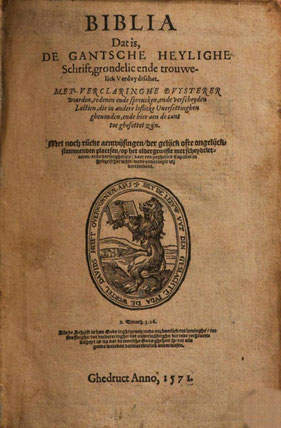
Title 1562: “BIBLIA: Dat is, DE GANTSCHE HEYLIGHE SCHRIFT, grondelick ende trouvvelick verduydtschet, Met verklaringhe duysterer woorden, redenen ende spreucken, ende verscheyden Lectien, die in andere loflicke Ouersettinghen gheuonden, ende hier aen de kant toe ghesettet zijn: Met noch rijcke aenwijsinghen, der ghelijck ofte onghelijckstemmenden plaetsen, op het allerghewiste met scheydtletteren, ende versen ghetale (daer een yeghelick Cap. na Hebreischer wijse, mede onderdeylt is) verteeckent. [vignet:] HET RIKE DER HEMELEN IS ALS EEN VERBORGEN SCHAT IN DEN ACKER MATH 13. Ghedruckt te Embden, Anno, 1562. den 7. Martij.”
Translated 1562: “BIBLE: That is, THE HOLY SCRIPTURES, thoroughly and faithfully explained, with explanations of obscure words, reasons and proverbs, and various lessons found in other praiseworthy translations, and added here in the margins: With rich references to similar or dissimilar passages, marked with separate letters and verse numbers (each chapter being divided according to the Hebrew method). [vignette:] THE KINGDOM OF HEAVEN IS LIKE A HIDDEN TREASURE IN THE FIELD MATH 13. Printed in Embden, Anno, 1562. on 7 March.”
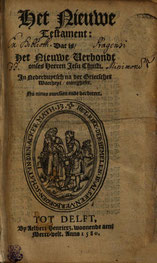
Title NT 1611: “Het Nieuwe Testament, dat is, het Nieuwe Verbondt onses Heeren Jesu Christ.”
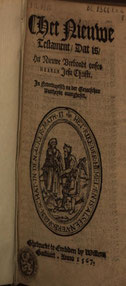



Facsimiles:
1562 Deux-Aes Bible, info, Wikipedia
1562 Deux-Aes Bible, scan and digital text (bijbelsdigitaal), Link-2
1562 Deux-Aes Bble, digital text (dbnl)
1562 Deux-Aes Bible, Emden: Godfried van Wingen, Johannes Dyrkinus (Google Books) p
1567 Deux-Aes NT, Embden: by Willem Gailliart (Google Books)
1571 Deux-Aes Bible, Jan Canin (Archive)
1571 Deux-Aes Bible, Jan Canin (GB), GB-2, GB-3, GB-4, GB-5
1580 Deux-Aes Bible, Dordrecht (Regensburg, Staatliche Bibliothek - 999/2Script.84), Google Books
1580 Deux-Aes NT, Delft: by Aelbert Henricxz. woonende aent Merct-vel (GB)
1581 Deux-Aes Bible, by Aelbert Hendricksz (Google Books), GB-2, HathiTrust
1582 Deux-Aes Bible, Delft: by Aelbert Hendricksz (GB)
1608 Deux-Aes Bible, by Jan Paedts Jacobszoon ende Jan Bouwenszoon (GB), GB-2
1611 Deux-Aes NT, Delf: Bruyn Hermanszoon Schinckel (GB)
1647 Deux-Aes NT, Dutch-French, Rotterdam: Pieter van Waesberge (GB)
Augustin Marlorat (Augustin Marlorat du Pasquier, Augustinus Marloratus, *1506; †1562; Wikipedia) revised the NT of the Deux-Aes Bible only slightly, but he added numerous annotations to it.
Title 1568: Het Niewe Testament. Dat is: Het nieuwe Verbondt onses Heeren Jesu Christi. Jn Nederduytsche na der Griecscher waerheyt ouergeset. Met de Annotatien August. Marlorati aldereerst overgeset wt de Franchoysche in de Nederduytsche Sprake. Hier is ock bygenoecht: Eenen Kalendier Historiael, met de... Wederom oversien ende ghecorrigeert.(Catechismus Ofte Onderwijsinge in de Christelicke leere also die in de Kercken ende Seholen de Kueruorstelicken Paltz gheleert wordt. ... In Nederlantsche sprake ouergeset Door Petrum Dathenum).
Translated: The New Testament. That is: The New Covenant of our Lord Jesus Christ. Translated into Dutch from the Greek truth. With the annotations of Augustus Marlorati, first translated from French into Dutch [literally: Low German Language]. Here is also included: A Historical Calendar, with the... Revised and corrected. (Catechism Or Instruction in Christian Doctrine as taught in the Churches and Schools of the Electoral Palatinate. ... Translated into Dutch by Petrum Dathenum).


Facsimiles:
1568 Marlorat NT, Emden: Willem Gailliart (Staatsbibliothek Berlin, VD16 ZV 30632)
1568 Marlorat NT, (Google Books from British Library)
1568 Marlorat NT, Vol.1 (Google Books from Nat. Library), Link-2
1568 Marlorat NT, printed in in Gouda bij Jasper Tournay (bibliotheken.nl)
1581 Marlorat NT, Leyden: Jacobzoon, Jan Paets (Archive)
1596 Marlorat NT (National Library of Australia)
1599 Marlorat NT, Leyden: by Jan Claesz. Dorp (Google Books)
1611 Marlorat NT, Amsterdam: voor Willem Adriaensz Ocker (Google Books)
1629 Marlorat NT, Amsterdam: Hendrick Laurensz (Google Books)
Moerentorf Bijbel 1599
Jan Moerentorf (Jan Moretus, Jan Mourentorf, John Moerentorf; 1543 -1610; Wikipedia) was a Flemish printer who was an apprentice for Christophe Plantin, married his daughter, and later inherited the printing business on his father-in-law's death. en Jan van Keerberghen. In 1599, he produced a revision of the catholic Leuven Bible in Antwerp (Moerentorfbijbel), which had been corrected according to the “Roman text” (meaning the Vulgate). In 1646, this Dutch catholic Vulgate Bible was revised once again by Henricus van den Leemputte and illustrated with numerous images by Christoffel van Sichem, see Leelputte 1646.

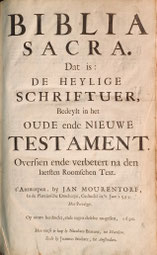
Title 1599: “BIBLIA SACRA. Dat is De geheele Heylighe Schrifture bedeylt int Oudt ende Nieu Testament: Van nieus met groote neersticheyt oversien, ende naer den lesten Roomschen tekst verbetert, door sommighe Doctoren inder Heyligher Godtheyt inde vermaerde Universiteyt van Leuven. T'Antwerpen By Ian Moerentorf. Anno MDXCIX [1599]”
Translated 1599: “BIBLIA SACRA. That is, The entire Holy Scripture contained in the Old and New Testaments: newly revised with great diligence, and corrected according to the latest Roman text, by certain Doctors of the Holy Godhead at the renowned University of Leuven. Antwerp By Ian Moerentorf. Anno MDXCIX [1599].”
Title 1599 NT: “Het Nieuwe Testament ons saligmakers Jesu Christi. Op nieuw herdrukt naar de uitgave van Jan Mourentorf te Antwerpen 1599.”
Translated 1599 NT: “The New Testament of our Savior Jesus Christ. Reprinted from the edition by Jan Mourentorf in Antwerp, 1599.” The NT has been reprinted several times, but the year was often not specified.
Title 1714: “Biblia Sacra. Dat is: De Heylige Schriftuer, bedeylt in het Oude en Nieuwe Testament. Oversien ende verbetert na den laetsten Roomschen Text. en nu op nieus verciert met een seer deftige voor-reeden, door de seer eerwaerdige en uytnumtende Heerec, Fr. Thomas du Jardin en Fr. Franciscus d' Engbien, beyde van de Ordre van den H. Dominicus, en Doctoren in de H. Godheyd, in de Hooge Schoole van Loven. T' Antwerpen. Voor Petrus Jouret, Stads-Drucker ende Bockverkooper op de Melck-Merckt, in Gulde - tralie.”



Facsimiles:
1599 Moerentorf Bible, T'Antwerpen: By Ian Moerentorf (Google Books), Link-2
1599 Moerentorf NT, Antwerpen (Google Books), Link-2, Link-3, Link-4, Adebooks color image
1690 Moerentorf Bible, Harlem: Nicolaes Bracuw (adebooks)
1714 Moerentorf Bible, Antwerpen: Petrus Jouret (ÖNB, 7.P.17 ALT PRUNK), Link-2
1714 Moerentorf Bible, Antwerpen: Thomas du Jardin, Franciscus d' Enghien (GB), GB-2, GB-3
1743 Moerentorf Bible, Amsterdam: Cornelis Stichter (GB)
182? Moerentorf NT, Petrus den Hengst en Zoon (Google Books)
1834 Moerentorf NT, Enschedé & Zonen (Google Books)
1838 Moerentorf Bible, Brussel: Meline, Reprint of 1599 (Augsburg, Th B VIII.24 1), Link 2
1838 Moerentorf Bible, Brussel: Meline, Reprint of 1599 (Archive)
1838 Moerentorf Bible, Brussel: Meline, Reprint of 1599 (GB), GB-2, GB-3, GB-4, GB-5
Dutch Bibles since 1600
As has been shown, a flood of Dutch Bibles were published in the 16th century. It was the golden age of Dutch Bible production. Due to the large number of Bibles, this website had to be divided: The Dutch Bibles since 1600 are shown separately (Link).
Copyright info and disclaimer: All content, all links and all photos from ancient and new Bibles provided on this website is for informational purposes only. We make no representations as to the accuracy or completeness of any information on this website or found by following any link on this website. We will not be liable for any errors or omissions in this information. We will not be liable for any losses, injuries, or damages from the display or use of this information. We can not guarantee the validity and accuracy of the information, please always check the original source. The opinions expressed from other website owners and those providing comments are theirs alone, and do not reflect the opinions of us. If an error should be found or if additional information should be included, please send us a message and we will update it as soon as possible.