ICELANDIC BIBLES - Facsimiles & Download
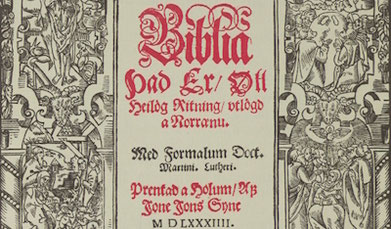
"The history of Bible translations into Icelandic began with the country's conversion to Christianity around 1000 CE but efforts accelerated with the Icelandic Reformation in the mid-16th century.
Since then, 11 complete translations of the Bible have been completed into Icelandic.
Currently, the Icelandic Bible Society oversees translation and production of Icelandic-language Bibles with the most recent full translation completed in 2007.
Pre-Reformation
With the Christianization of Iceland, so-called þýðingar helgar (weekend translations) were written in Old Norse/Old Icelandic to help explain the new religion and practices to the populace. These included religious interpretations alongside translations of Bible stories. The oldest Icelandic biblical texts date to c. 1200 when the Old Icelandic Homily Book, which compiled sermons, lessons, and prayers.[1] During the following century, more systematic efforts were made to translate sections of the Bible, eventually being collected into the Stjórn around 1350.
By the early 16th century, the only Icelandic translation available was Catholic Bishop Jón Arason's translations of the four Gospels, although copies of this work have not survived.
Post-Reformation
When the Reformation reached Iceland in the mid-16th century, a full translation of the Bible into Icelandic was needed. This work began with a translation of the New Testament by Oddur Gottskálksson published in Roskilde in 1540 (text here). Oddur's translation followed the Latin Vulgate with reference to Martin Luther's 1552 German translation.
Guðbrandur Þorláksson, the Protestant bishop at Hólar, published the first complete translation, the Guðbrandsbiblía, in 1584. Guðbrandur's Old Testament translation was based on Luther's 1534 full German translation and Christian III's 1550 Danish translation. The New Testament used Oddur's translation with corrections. It is believed that Oddur translated the Psalms and Gissur Einarsson translated the Book of Proverbs and Book of Sirach. It is possible Guðbrandur himself translated other books of the Old Testament.
Afterwards, a number of other translations followed, such the 1644 Þorláksbiblía [is] overseen by Bishop Þorlákur Skúlason and printer Halldór Ásmundsson in Hólar and the 1747 Waysenhússbiblía printed by Det Kongelige Vajsenhus in Copenhagen. In 1813, in the same city, the British Bible Society published the Grútarbiblía [is] (or Hendersonsbiblía), just two years before the founding of the Icelandic Bible Society by the British Bible Society's Ebenezer Henderson.
A new translation, the Viðeyjarbiblía [is], was released in 1841 and revised in 1863 by Pétur Pétursson and Sigurður Melsteð, who compared it with the Greek and Hebrew originals and with the Norwegian, Danish, English and French versions. This edition (just the New Testament and Psalms) was edited by Eiríkur Magnússon and reprinted in 1866 in two editions: a single volume with the New Testament and Psalms and a set with the full Old and New Testaments. Both the 1863 and 1866 editions were printed by the British Bible Society at Oxford. These translations were used for the 1903 illustrated New Testament of the Scripture Gift Mission (London & Akureyri). By 1906, the British Bible Society was printing in Reykjavík a new New Testament translation based on the original texts by Haraldur Níelsson [is] and, in 1908, the entire Bible.
The current publisher of the Icelandic Bible is the Icelandic Bible Society, which was founded on 10 July 1815 with the goal of making the Bible widely available and accessible in Iceland. In 1859 it printed the so-called Reykjavíkurbiblía [is], essentially the Viðeyjarbiblía from 18 years earlier. By 1899, the society was printing the Old Testament translations of Þórir Kr. Þórðarson, which were used into the early 21st century. The latest full translation, a new complete translation by Guðrún Guðlaugsdóttir, was published in 2007" (Wikipedia).
11 Icelandic Versions of the Complete Bible
In total, 11 Icelandic versions of the complete Bible have been published with revisions made with each new version. There are also some additional New Testaments (see Wikipedia and Wikipedia). The printing location is indicated in green:
New Testament translations include:
- 1540 Nýja testamenti Odds Gottskálkssonar Hróaskeld [is] (Denmark, Roskilde [dn] is the danish name of the city)
- 1609 Nýja testamenti Guðbrands, Hólar
- 1746 and 1750 Waysenhúss-Nýja testamenti, Copenhagen
- 1807 Nýja testamenti, Copenhagen
- 1825 and 1827 Nýja testamentið, Viðey
- 1851 Nýja testamentið, Reykjavík
- 1863 and 1866 Nýja testamentið, Oxford
- 1903 Nýja testamentið, Akureyri and London
- 1906 and 1914 Nýja testamentið (Ný Þýðing), Reykjavík (reprinted)
11 Translations of the full Bible:
- 1584 Guðbrandsbiblía, Guðbrandur Þorláksson's Bible, Hólar (1st Icelandic Bible)
- 1637–1644 Þorláksbiblía [is], Þorlákur Bible, Hólar (2nd Icelandic Bible)
- 1728 (1734) Steinsbiblía [is], The Steinn's Bible, Hólar (3rd Icelandic Bible)
- 1747 Waysenhússbiblía, The Bible of Vejsenhusc, Copenhagen (4th Icelandic Bible)
- 1813 Grútarbiblía [is], (Hendersonsbiblía), The Hendersson's Bible, Copenhagen (5th Icelandic Bible)
- 1841 Viðeyjarbiblía [is], The Bible of Viðey, Viðey (6th Icelandic Bible)
- 1859 Reykjavíkurbiblía [is], Bible of Reykjavík, Reykjavík (7th Icelandic Bible)
- 1866 Lundúnabiblía [is], The Bible of London, London (8th Icelandic Bible)
- 1908-1912 Biblía 20. aldar [is], The Jahve Bible, Reykjavík (reprinted) (9th Icelandic Bible)
- 1981 Biblían 1981 (=Þýðingin 1981) [is], Reykjavík (10th Icelandic Bible)
- 2007 Biblía 21. aldar [is], Reykjavík (11th Icelandic Bible)
Nýja testamenti Odds Gottskálkssonar - NT of Oddur Gottskálksson - 1540
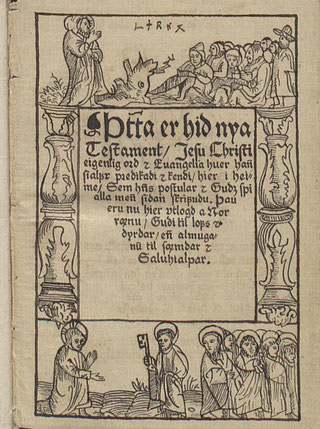
"Nýja testamenti Odds Gottskálkssonar Hróarskeldu 1540." Translated: "The New Testament of Oddur Gottskálksson from Hróaskeld 1540". "Oddur Gottskálksson's translation of the New Testament was printed in Hróaskelda in 1540. This would be the first printed book in Icelandic. Oddur Gottskálksson was the son of Gottskálk "the Fierce" Nikulásson, Bishop of Hóla, and had become acquainted with Lutheranism during his travels in Norway, Denmark and Germany after his father's death in 1521. In 1534 or 1535 he returned to Iceland and entered the service of Ögmundur Pálsson, Bishop of Skálholt, as a scribe. Oddur may have already begun translating the New Testament based on Martin Luther's German translation and the Vulgate, the official Latin version, in 1534 or 1535. He would have lived in the barn at Skálholt, both to conceal his activities from Ögmundur and also because of the heat. He said to Gísli Jónsson, another of the group of reformers in Skálholt: “Jesus, our redeemer, was laid in a donkey stall, but now I begin to interpret and translate his word into my native language in a stable.” A few years later, he moved to Reykjavík in Ölfus and completed the translation there.
In the spring of 1539, Oddur traveled to Denmark, possibly in company with Gíssur Einarsson, who was on his way there to be consecrated as a bishop. He submitted the translation to King Christian III of Denmark, who writes on November 9, 1539, that he had had learned men compare the translation with the Latin text and that they considered it correct. After this, Oddur was able to have the translation printed in Hróaskelda, which he did at his own expense. The printing was completed on April 12, 1540.
The translation is a remarkable work of innovation, as Oddur constructed, for example, many neologisms that are still in use. For example, words such as “to curse” (existed before but meant everything else), “overcooked”, “sourdough” and “brjóstmylkingur”. The impact of the translation on the Icelandic language was therefore great. Odd’s translation was adopted with minor changes in the Guðbrandsbiblía of 1584 and a considerable part of it still appears in modern editions. Each chapter of the New Testament has a preface “whereby the simple man may be instructed and led away from his ancient ignorance to the right level and what he should think of this book, so that he may seek there no commandments or laws when he should seek the gospel and the promises of God”. These prefaces are translated from Luther’s New Testament translation from 1522" (translated, Wikisource).
Title: "Þetta er hið nýja Testament Jesu Christi eiginleg orð og Evangelia hver hann sjálfur predikaði og kenndi hér i heimi sem hans postular og Guðspjallamenn síðan skrifuðu. Þau eru nú hér útlögð á Norrænu, Guði til lofs og dýrðar en almúganum til sæmdar og Sáluhjálpar." Translated: "This is the New Testament of Jesus Christ, the actual words and Gospels which he himself preached and taught in this world, which his apostles and evangelists later wrote. They are now here translated into Norse, to the praise and glory of God, and to the honor and salvation of the common people.."
Facsimiles:
1540 Oddur NT, Version 1 (Baekur.is)
1540 Oddur NT, Version 1 (Archive)
1540 Oddur NT, Version 2 (Baekur.is), Link 2
1540 Oddur NT, Version 2 (Archive), Link2
1540 Oddur NT, Version 3 (Baekur.is)
1540 Oddur NT, Version 3 (Archive)
1540 Oddur NT, digital text (Wikisource)
1540 Oddur NT, modern text PDF (Archive), Link2-endtimemanna
Guðbrandsbiblía, Hólum - Gubrandur Thorlaksson's Bible - 1584
The Guðbrand's Bible (Wikipedia, Wikimedia) was named after its editor Gubrandur Thorlaksson (=Guðbrandur Þorláksson; *1541; † 20. Juli 1627; Wikipedia) and was the first translation of the full Bible into the Icelandic language. It was the Protestant Bible for Iceland. This Icelandic translation was financed by the King of Denmark and patterned after Martin Luther's German translation. "It is said that seven people worked on printing the volume and that it took them 2 years to print 500 copies. Each printed copy was expensive, costing the equivalent of 2-3 cows, depending on the wealth of the prospective buyer " (Source).
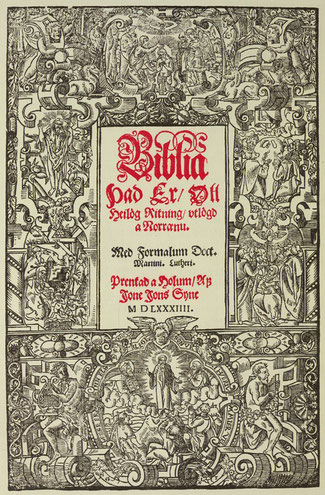
"Guðbrandur Þorláksson (1541/42 – 1627) studied at the cathedral school at Hólar in the north of Iceland before attending the University of Copenhagen. After he returned home, Gudbrandur was appointed rector of the school at Skálholt in the south of Iceland for a three year term, and then minister at Breidabólstadur in the north of Iceland until he himself became bishop of Hólar, a position he held until his death in 1627.
He was an energetic editor and publisher. A total of 80 books are known to have been printed while he was bishop. These were chiefly religious works, the Bible of course being the largest and most important, but his worldly books included the Lawbook of Icelanders published in 1578.
Gudbrandur’s Bible consists of 662 folio leaves, each 29 x 19 cm (including marginal references and notes). It is said that it took seven men two years to print it. Originally 500 copies were printed, of which there are still between 30 and 40 copies extant in Iceland, one third of them held in private ownership. It is not known how many copies have been preserved outside Iceland.
The book is divided into three sections, first the Old Testament (ff. 6 + 295), then the Prophets (ff. 4 + 192), and then the New Testament (ff. 1 + 123 + 1). A foreign bookbinder was hired, and he bound half of the number printed. An additional 120 copies were sent to Copenhagen to be bound and the rest were assigned to an Icelander who had learned bookbinding from the foreigner. The book was expensive, the price equivalent to two to three cows. Each church was required to purchase a copy of this Bible, and in addition the publication was supported by a Royal grant.
This Bible was printed with schwabacher lettering, like most books in Iceland at that time. The letters are clear and most of the printing was very well done. Regarded as an innovation in Icelandic publishing for the time, Gudbrandur’s Bible features 29 woodcuts (of which two are printed twice); it has been shown that the bishop acquired them from abroad. The decorated initial letters and the ornaments were quite conceivably made by the bishop himself, as it is known that he was an accomplished carver.
Bishop Gudbrandur made an important contribution to the translation of the Bible, though others had already translated specific parts into Icelandic. The fact that the Bible and other Lutheran books appeared so early in Icelandic, helped to ensure the continuity of the language of the ancient Icelandic literature down to our own time.
Bishop Gudbrandur was well educated and in addition to theology, was interested in mathematics, astronomy and geography; in this connection he made a map of Iceland, the first that was close to presenting the real configuration of the land.
Two facimile editions of Gudbrandur’s Bible have appeared, in 1956–57 and again in 1984.
References: Bandle, Oskar. Die Sprache der Guðbrandsbiblía. Hafniæ 1956. (Bibliotheca Arnamagnæana, 17.). Westergård-Nielsen, Chr. To bibelske visdomsbøger og deres islandske overlevering. København 1957. (Bibliotheca Arnamagnæana, 16). Magerøy, Ellen Marie: Planteornamentikken i islandsk treskurd. I. Tekst. II. Plansjer. København 1967. (Bibliotheca Arnamagnæana. Suppl. 5-6.)" Source.
Title: "Biblia þad er Øll Heilog Ritning, vtlögd a Norrænu. Med formalum Doct. Martini Lutheri. Prentad a Holum/Af Jone Jons Syne". Translated: "Bible, that is the entire Holy Scriptures translated into Nordic (Icelandic). According to the version of Dr. Martin Luther."
Facsimiles:
1584 Guðbrand's Bible, Hólar (Princeton)
1584 Biblía það er öll heilög ritning Vol 1, OT (Bækur.is), Link2, Link3
1584 Guðbrand's Bible - OT, VOl. 1, Gamla testamentið (Archive), Link2, Link3
1584 Biblía það er öll heilög ritning Vol 2, OT, Prophets, Apocrypha (Bækur.is), Link2
1584 Guðbrand's Bible - OT, Vol. 2, Spámannabækurnar, Books Of The Prophets & Apocrypha (Archive), Link2
1584 Biblía það er öll heilög ritning, NT, Vol 3 (Bækur.is), Link2, Link3
1584 Guðbrand's Bible - NT, Vol. 3 (Archive), Link2, Link3
1584 Guðbrand's Bible - NT, modern text (Archive)
1584 Guðbrandsbiblía, digtial Text (Biblian.is)
1956 Guðbrandsbiblía, Facsimile of the first translation into Icelandic of the Bible (Google Books)
Nýja testamenti Guðbrands, Hólum 1609
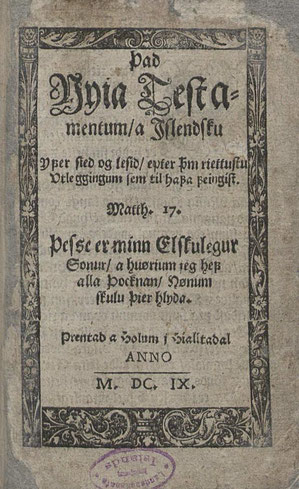
Gubrandur Thorlaksson (Guðbrandur Þorláksson; 1541-1627 (Wikipedia) published a new New Testament in 1609. However, it was not a copy of his complete Bible "Guðbrandsbiblía" from 1584, but a new edition. What makes it special is that he introduced the word “Sabbath” into the New Testament for the first time, whereas earlier Bibles referred to the Sabbath as “washing day” (þvottdagur) or "bath day" (laugardagur). Its name comes from the fact that it was once customary for people to bathe, that is, take a bath, on this day. In modern Icelandic, Saturday is still called Bathing Day (laugar·dag, Laugardagur). Sunday is called sunnudagur after the sun (former worship of the sun god).
Author: Luther, Martin, 1483 - 1546; Guðbrandur Þorláksson 1541 - 1627
Title: "Það Nýja Testamentum"
Facsimiles:
1609 Iceland NT, Hólum (Baekur)
1609 Iceland NT, Hólum (Archive)
Title: "Psalma Bok Islendsk"
Facsimiles:
Þorláksbiblía, Hólar - Þorlákur's Bible - 1637-1644
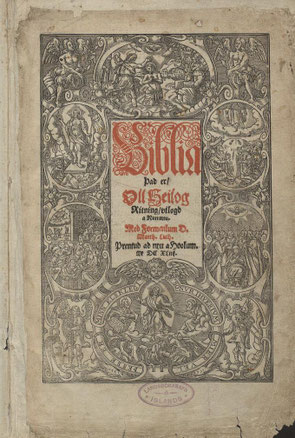
The Þorlák Bible (Þorláksbiblía, Wikipedia) is the second complete edition of the Bible in Icelandic, printed in Hólar (Hólar í Hjaltadal) and named after Bishop Þorlák Skúlason (=Thorlákur Skúlason; Wikipedia) there. There are only four illustrations in the book, compared to 30 in the Guðbrandsbiblía. The initial letters of chapters and other decoration are mostly taken from the Guðbrandsbiblía. Þorlákur's Bible had one advantage, however: It uses numerical verse division for the first time, whereas in the Guðbrandsbiblía only the chapters were numbered.
"Guðbrandur’s grandson, Þorlákur Skúlason (1597-1656), who became the next Bishop at Hólar (1628-1656), published a Bible in two parts, in 1638 and 1644. Þorlákur’s Bible is the second version of the Icelandic Bible. It largely follows Guðbrandur’s version with some corrections. According to the Danish king’s order, Þorlákur was obliged to follow a Danish version that Hans Resen, who later became the Bishop of Sjaelland, had translated directly from Hebrew and Greek and published in 1607. In this second version in Icelandic, the chapters were divided into verses for the first time, alhough such an innovation had been started some decades earlier. Be that as it may, the division of the Biblical books into chapters had been practised earlier, as it had also been done both in Oddur Gottskálksson’s New Testament and Guðbrandur’s complete Bible." (source).
People involved: Luther, Martin (1483-1546); Þorlákur Skúlason (1597-1656; Wikipedia); Oddur Gottskálksson (1514-1556; Wikipedia); bishop Gissur Einarsson (1512-1548; Wikipedia); printer Halldór Ásmundsson (1600-1667; Wikipedia).
Publisher: Þorlákur Skúlason (1597-1656; Wikipedia).
Title: "Biblia pad er øll Heilög Ritning, vtlögd Norraenu med formailum og atskÿringum M. Lutheri" Translated: "Bible, that is the entire Holy Scriptures translated into Nordic (Icelandic) according to the version of Dr. Martin Luther."
Facsimiles:
1642 Þorlák Bible (Mary Baker Eddy Library)
1644 Þorlák Bible, Vol.1 OT, Hólar (Baekur)
1644 Þorlák Bible, Vol.1 OT, Hólar (Archive)
1644 Þorlák Bible, Vol.2 OT, Spámannabækurnar, Prophets, Hólar (Baekur)
1644 Þorlák Bible, Vol.2 OT, Spámannabækurnar, Prophets, Hólar (Archive)
Steinsbiblía, Hólum - Steinn's Bible - 1728
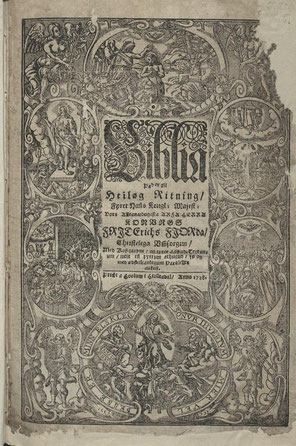
"The third version of the Bible was published in 1728. Bishop Steinn Jónsson (1660-1739; [Wikipedia]), who also presided at Hólar (1711-1739), was the publisher. According to the Danish king’s order, Steinn was obliged to bring the text closer to the Danish language, probably Hans Svane’s translation of 1647. This version had a very poor reputation, and was the last one to be printed in Hólar" (source).
The printing of the Bible began in 1728, and that year is on the title page, but the printing was not completed until 1734. The printing of the Steinn's Bible must have taken 6 years, with some breaks, because more books were being printed in Hólar during that period. It is uncertain how many copies the book had, perhaps 1,000 copies.
The Steinsbiblía is a slightly smaller volume than the Guðbrandsbiblía and the Þorláksbiblía, and is therefore somewhat thicker than them. It was printed in two columns, which was a change from previous editions. The Steinsbiblía is inferior to its predecessors in all respects. Luther's prefaces, which had been in previous Bibles, were now omitted.
Title: "Biblía það er öll heilög ritning" Translated: "Bible that is all holy scripture"
Facsimiles:
1728 Steinsbiblía, Vol.1 (Baekur)
1728 Steinsbiblía, Vol.1 (Archive)
1728 Steinsbiblia, Vol.1, Hoolum (Signatur: 57.D.17.(Vol 1); ÖNB), Link2
1728 Steinsbiblía, Vol.1, Hoolum (Google Books)
1728 Steinsbiblía, Vol.2 (Baekur)
1728 Steinsbiblía, Vol.2 (Archive)
1728 Steinsbiblía, Vol.2, Hoolum (Google Books)
1728 Steinsbiblía, Vol.3 (Baekur)
1728 Steinsbiblía, Vol.3 (Archive)
1728 Steinsbiblía, Vol.4, Apocrypha (Baekur)
1728 Steinsbiblía, Vol.4, Apocrypha (Archive)
Waysenhúss-Nýja testamenti, Kaupmannahöfn 1746 and 1750
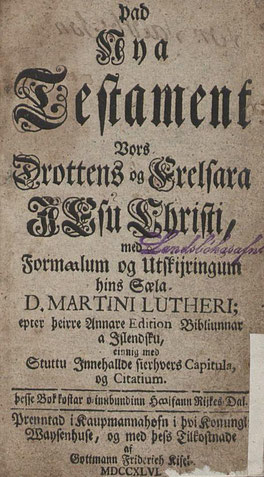
The New Testament of the Waysenhússbiblía (Vajsenhússbiblía; Wikipedia) was released in August 1746 as an inexpensive duodecimo edition, which at a half Danish rigsdaler would be affordable to the poor. At the same time a larger quarto edition of the New Testament was prepared. In October 1747, the Old Testament was completed in the same format.
The full Bible numbered 1,742 pages and 1,000 copies were produced. The cost of the finished book was 1 rigsdaler unbound or 2 rigsdaler bound, thanks to a subsidy from the churches of Iceland. Demand for the Waysenhússbiblía was high and in 1750 an additional 2,000 copies of the duodecimo New Testament were reprinted in the same format.
By: Luther, Martin 1483-1546; Jón Þorkelsson 1697-1759.
Publisher: Prenntad ... i þvi Konungl: Waysenhuse, og med þess Tilkostnade.
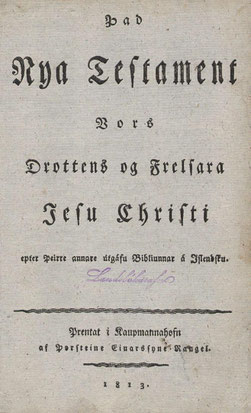
Title: "Þad Nya Testament Vors Drottens og Frelsara JEsu Christi" Translated: "The New Testament of Our Lord and Savior Jesus Christ"
Facsimiles:
Waysenhússbiblía, Kaupmannahöfn - The Bible of Vejsenhus - 1747
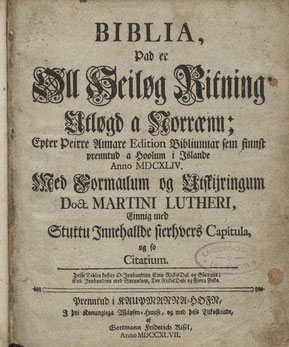
"The fourth version of the Icelandic Bible was the so-called Bible of Vejsenhus, published in 1747 by the Royal Vajsenhus, an orphanage which had recently been founded and to which the Danish king had given the copyright to publish Bibles in Denmark, which in fact it still has" (source).
The Waysenhús Bible (Wikipedia) had a circulation of 1,000 copies. In 1750 the New Testament was reprinted in 2,000 copies, in the same edition as before. In order to further promote the spread of the Scriptures, a Danish merchant, Laurenz Stistrup, arranged for about 600 Bibles and 1,700 New Testaments to be distributed to the poor.
Title: "Biblia, pad er, Öll Heilog Ritning utlögd a Norraenu ... med formailum og atskÿringum M. Lutheri ..."
By: Luther, Martin 1483-1546; Jón Þorkelsson 1697-1759 (Wikipedia).
Printed in Cppenhagen (Kaupmannahöfn): Gottmann Friederich Risl, "I þvi Konunglega Wäysen-Huuse, og med þess Tilkostnade" - Translated: "In the Royal Wäysen-Huuse, and with it the Cost"
Facsimiles:
1747 Vejsenhus Bible, Vol.1, OT (Baekur)
1747 Vejsenhus Bible, Vol.1, OT (Archive)
1747 Vejsenhus Bible, Vol.1, OT (Hathitrust)
1747 Vejsenhus Bible, Vol.1 (Google Books)
1747 Vejsenhus Bible, Vol.2, Apocrypha (Baekur)
1747 Vejsenhus Bible, Vol.2, Apocrypha (Archive)
1747 Vejsenhus Bible, Vol.2, Apocrypha (Hathitrust)
Nýja testamenti Hendersons, Kaupmannahöfn 1807
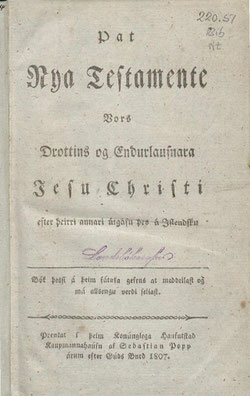
Title: "Þat Nya Testamente Vors Drottins og Endurlausnara Jesu Christi efter Βeirri annari utgafu Βes à Islendsku." Translated: Title: "The New Testament of Our Lord and Redeemer Jesus Christ after these other editions in Icelandic"
By: Grímur Jónsson Thorkelín (1752-1829; Wikipedia)
Print: Copenhagen (Kaupmannahaúfn: Popp)
Facsimiles:
1807 NT (BSB, Th B VIII.38 1), Link2 B.rel. 83 h
Grútarbiblía, Hendersonsbiblía, Kaupmannahöfn - The Henderson's Bible 1813
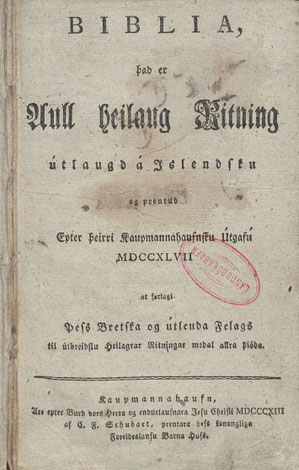
The Grútarbiblía or Hendersonsbiblía (Wikipedia), 1813, is the fifth complete edition of the Bible in Icelandic, printed in Copenhagen.
"In fact, the New Testament had already been published in 1750 and 1807. This version was published on the initiative of the British and Foreign Bible Society which had been founded in 1804. Its purpose has always been the distribution of the Holy Scriptures throughout Britain and the entire world. This Bible was very welcome even though there were some printing errors and the paper was of poor quality. The text of this Bible was in full agreement with the Vajsenhus Bible apart from the omission of Luther’s Foreword and the apocryphal books. The British and Foreign Bible Society would not acknowledge the latter and did not wish to sponsor the publication of a Bible that contained them. The Scotsman Ebenezer Henderson (1784-1850; [Wikipedia]) travelled around Iceland in 1814 and 1815 and distributed Bibles. It was at his initiative that the Icelandic Bible Society was founded on July 10th, 1815, which will therefore celebrates its 200th anniversary in 2015" (source)
Title: "Biblia, þad er aull heilaug Ritning útlaugd á Islendsku og prentud epter þeirri Kaupmannahufnsku Utgafú MDCCXLVII, etc." Translated: "The Bible, the whole Holy Scripture translated into Icelandic and printed after the Copenhagen Edition, MDCCXLVII, etc."
Publisher: "at forlagi Þess Bretska og útlenda Felags til útbreidslu Heilagrar Ritningar medal allra þióda" - Translated: "published by The British and Foreign Society for the Distribution of the Holy Scriptures among all nations"
Facsimiles:
1813 Henderson's Bible, Copenhagen (Baekur)
1813 Henderson's Bible, Copenhagen (Archive)
Nýja testamentið, Viðey 1825 and 1827
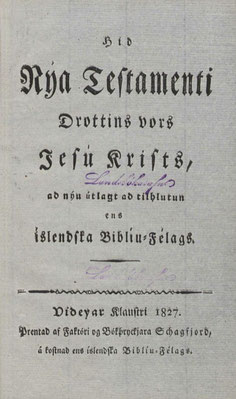
Author: Geir Vídalín 1761 - 1823 ; Sveinbjörn Egilsson 1791 - 1852 ; Árni Helgason 1777 - 1869 ; Ísleifur Einarsson 1765 - 1836 ; Steingrímur Jónsson 1769 - 1845 ; Jón Jónsson 1777 - 1860 ; Hallgrímur Scheving 1781 - 1861 ; Guðmundur Jónsson Skagfjörð 1758 - 1844.
Publisher: rentad á kostnad ens íslendska Biblíu-Félags
Title: "Hið Nýa Testamenti Drottins vors Jesú Krists". Translated: "The New Testament of Our Lord Jesus Christ"
Facsimiles:
Viðeyjarbiblía, Viðey - The Bible of Viðey - 1841
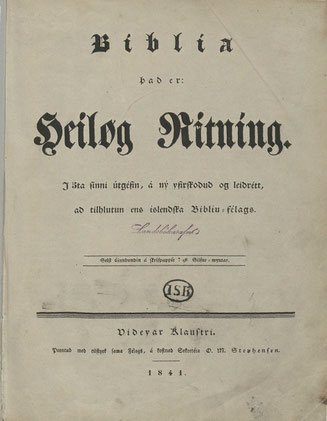
"This is the sixth Icelandic Bible edition. It was printed in Viðey and is traditionally named after that place. It was a new translation, but not entirely from the original languages. There are 1,464 pages. Those who contributed to the work were Árni Helgason (1777–1869), Ásmundur Jónsson (1808–1880), Geir Vídalín (1761–1823), Hallgrímur Scheving (1781–1861), Hannes Stephensen (1799–1856), Helgi Thordersen (1794–1867), Ísleifur Einarsson (1765–1836), Jón Jónsson in Möðrufell (1759–1846), Jón Jónsson in Steinnes (1808–1862), Jón Jónsson lecturer (1777–1860), Markús Jónsson (1806–1853), Ólafur E. Johnsen (1809–1885), Steingrímur Jónsson (1769–1845), Sveinbjörn Egilsson (1791–1852) and Þorsteinn Hjálmarsen (1794–1871). The verdict of history is that much was translated very beautifully. However, a popular tone hovered over the waters, both in word choice and spelling, in the spirit of the Fjölnirists. Scholars generally agree that, despite various shortcomings, the Viðeyjarbiblía is “a great improvement from the editions in Höfn in 1747 and 1813”, although it may be “somewhat behind the old Icelandic editions in external finish”. Its other name is Jedoksbiblía, after a mistranslation at one point in the Old Testament (First Kings 9.24). The circulation was about 1,400 copies" (source).
By: Árni Helgason 1777-1869; Sveinbjörn Egilsson 1791-1852; Jón Jónsson 1808-1862
Title: "Biblia þad er: Heiløg Ritníng. I 5ta sinni útgéfin, á ný yfirskodud og leidrétt, ad tilhlutun ens íslendska Biblíufélags. Selst óinnbundin á skrifpappir 7 rd. Silfurmyntar. Videyar Klaustri. Prentud med tilstyrk sama Félags, á kostnad Sekretéra O. M. Stephensen." Translated: "The Bible is: Holy Scripture. Published in its 5th edition, newly revised and certified, by the Icelandic Bible Society. Sold loose on writing paper 7 rd. Silver coins. Videyar Monastery. Printed with the support of the same Society, at the expense of Secretary O. M. Stephensen." Note: In fact, it was not the fifth but the sixth complete Icelandic Bible.
1840 Viðeyjarbiblía, Genesis and 23 Capitular of Exodus (Baekur)
1840 Viðeyjarbiblía, Genesis and 23 Capitular of Exodus (Archive)
1841 Bible of Videy, Viðey (Baekur)
Nýja testamentið, Reykjavík 1851 - The NT of 1851
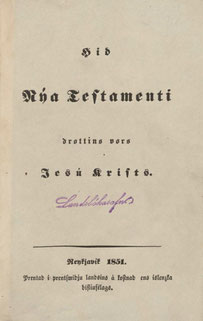
Title: "Hið Nýa Testamenti drottins vors Jesú Krists". Translated: "The New Testament of our Lord Jesus Christ"
Facsimiles:
Reykjavíkurbiblía, Reykjavík - The Bible of Reykjavik - 1859
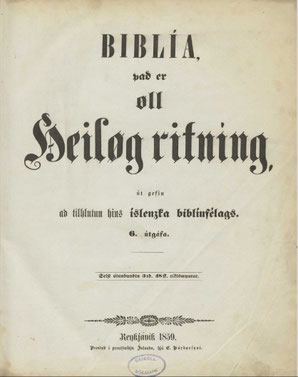
In the Reykjavíkurbiblía, the text of the Viðeyjarbiblía (1841) is printed almost unchanged. It contains the Apocryphal books of the Old Testament printed for the last time in Icelandic Bibles for a long time. They were again included in the 21st Century Bible, which was published in 2007 (Wikipedia). The Reykjavíkurbiblían was published in 2,000 copies.
"The seventh version of the Icelandic Bible was printed in Reykjavík in 1859. The Icelandic Bible Society sponsored this version, and the apocryphal books were again included. In fact, the apocryphal books were included in all Icelandic Bible versions, apart from those which the British and Foreign Bible Society sponsored. The text of this 1859 version contains the text from the 1841 Bible of Viðey, with some corrections" (source)
Title: "BIBLÍA, það er öll Heilög ritning, út gefin að tilhlutun hins íslenzka biblíufélags. 6. útgáfa".
The title page has a mistake, because it was not the 6th Bible, as stated, but the 7th Icelandic Bible.
Facsimiles:
1859 Bible of Reykjavik (Baekur.is)
1859 Bible of Reykjavik (Archive)
Nýja testamentið, Oxford 1863 and 1866
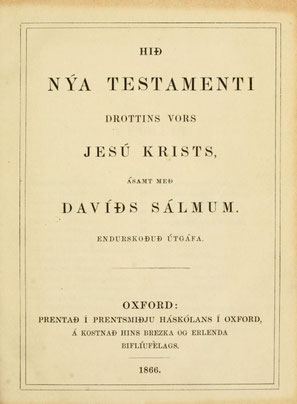
The 1866 NT is the reprint of the 1863 edition which was a revision of an [1841 and 1851] ed. The revision was "compared with the Greek and Hebrew, and with the Norwegian, Danish, English, and French versions, by Professor (afterwards Bishop) Pétur Pétursson ... and Sigurdur Melsted ... Edited by Eiríkr Magnusson..." Darlow & Moule, 5500. The same text was later included in the 1866 London Bible (Lundúnabiblía).
Title: "Hid nýa testamenti : drottins vors Jesú Krists ásamt me Davís Sálmum"
By: Pétur Pétursson, Bishop, 1808-1891; Eiríkr Magnússon, 1833-1913; Melsteð, Sigurður, 1819-1897
Print: Hins brezka og erlenda Biblíufèlags = British and Foreign Bible Society
Facsimiles:
Lundúnabiblía, London - The Bible of London - 1866
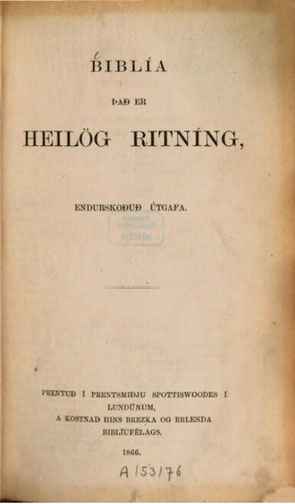
"One criticism of the 1841 and 1859 versions was that the text seemed to be incoherent, and consistency between each book had not been maintained; instead, each translator had left his own mark on his translation of the relevant book. Some people also felt that the language was too commonplace, and its majesty had been swept away. So a new translation, sponsored by the British and Foreign Bible Society, was started a little later. Pétur Pétursson (1808-1891), later Bishop of Iceland, and Sigurður Melsteð (1819-1895), who were professors at the Vicar College of Iceland, oversaw the revision and translated the New Testament again and proofread some parts of the Old Testament. This Bible version was published in 1866 and was printed in London. It was however very controversial, in that Pétur and Sigurður were accused of not having translated the Bible word for word, but had only corrected some texts from the Bible of 1859. However, this Bible was welcomed and accepted by Icelanders for the rest of the nineteenth century" (source).
Title: "Biblía, þađ er Heilög Ritníng... Lundúnum : A Kostnad hins Brezka og Erlenda Biblíufélags". Translated: "The Bible, that is, the Holy Scriptures... London: At the expense of the British and Foreign Bible Society" in London (Lundúnir).
Facsimiles:
1866 London Bible, Lundúnum, Spottiswoode (Archive)
1866 London Bible, Lundúnim: Brezka og Erlenda Biblíufélags (Hathitrust)
1866 London Bible, Lundúnum: Brezka og Erlenda Biblíufélags (BSB, B.rel. 162 v), Google Books
Nýja testamentið, Akureyri and London 1903
Nýja testamentið, Reykjavík 1906 and 1914
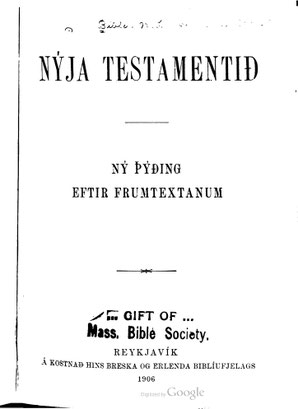
This NT has been reprinted many times.
Title: "NÝA TESTAMENTID. NÝ ÞÝĐING EFTIR FRUMTEXTANUM"
Print: Hins brezka og erlenda Biblíufèlags = British and Foreign Bible Society
Facsmiles:
Biblía 20. aldar - 20th Century Bible, The Jahve Bible - 1908-1912
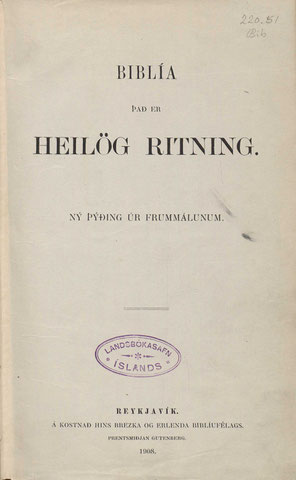
The 20th Century Bible (Wikipedia), or the 1908-1914 Bible, is the ninth complete edition of the Bible in Icelandic. Work began on it in response to the criticism that the London Bible had received. This Bible has been reprinted many times. "The administration of the Icelandic Bible Society applied for a financial assistance for a new translation of the Bible in 1887. Ten years later, in 1897, a young theologian, Haraldur Níelsson (1868-1928 [Wikipedia]), started translating the Old Testament. The Rev. Gísli Skúlason (1877-1942) worked with him on this. The Rev. Þórhallur Bjarnarson (1855-1916 [Wikipedia]), the Rev. Eiríkur Briem (1846-1929), and the Rev. Hallgrímur Sveinsson (1841-1909 [Wikipedia]) translated the New Testament. The Revs. Þórhallur and Hallgrímur, along with the poet Steingrímur Thorsteinsson (1831-1913 [Wikipedia]), sat on the commitee charged with proofreading and revising the whole text. The New Testament was published in 1906 and the whole Bible in 1908. But not everyone was happy with it. Apart from a number of shortcomings, it was criticised on the grounds that the Hebrew word ‘Jahweh’ was used instead of the Icelandic word ‘Drottinn’ (Lord). So this version of the Bible was revoked and republished in 1912 as the ninth version of the Icelandic Bible, but still including the word ‘Jahve’ for ‘Lord’ and ‘hinn smurði’ (‘the anointed one’) for Jesus Christ. Various place-names were corrected and controversial verses restored. The New Testament in general was revised and some parts of it were retranslated. The apocryphal books were not included in this Bible, but they were translated later on and published in 1931. This Bible was printed many times during the next decades, until the late 1970s" (source).
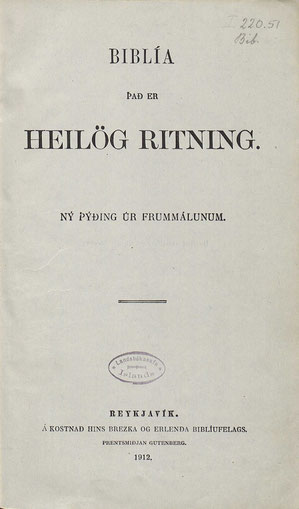
In the years 1899-1902, several samples of the translation were published, both from the Old and New Testaments. Comments were soon made, especially on the New Testament. This led to much writing and heavy words, as is often the case with new Bible translations. The comments were reviewed and the Bible was published in 1908. A revised edition was printed in London in 1912. But “Yahweh” was still in it. It was not until the Bible was published in paperback in 1914 that “Lord” took its place. That edition was reprinted several times, most recently in 1978. This story has raised questions about whether the 1908 edition should be considered a provisional edition, and whether this should be considered three editions, 1908, 1912, and 1914. However, this is generally seen as a single whole, or a development to a certain extent, because the bulk of the text is the same, despite changes here and there.
Title: "BIBLÍA, það er Heilög ritning. Ný þýðing úr frummálunum. Reykjavík. Á kostnað Hins brezka og erlenda Biblíufélags. Prentsmiðjan Gutenberg, 1908." Translated: "THE BIBLE, that is, the Holy Scriptures. A new translation from the original languages. Reykjavík. At the expense of the British and Foreign Bible Society. Gutenberg Press, 1908."
Facsimiles:
1908 20th Century Bible, Reykjavik (Baekur)
1908 20th Century Bible, Reykjavík (Archive)
1908 20th Century Bible, Reykjavík (Hathitrust)
1908 20th Century Bible, Reykjavik, PDF (Endtimemanna)
1912 20th Century Bible, Reykjavik (Baekur)
1949 20th Century Bible, London & Reykjavik (Archive)
1997 20th Century Bible, online edition of the Icelandic Bible Society - August 1997 (snerpa), OT 1997
Þýðingin 1981, Biblían 1981, Reykjavík - The Bible of 1981
The translation (Þýðingin) of 1981 or the Bible of 1981 (Biblían 1981; Wikipedia). This was actually a provisional edition, as it was only a new translation of the Gospels and the Acts of the Apostles.
"This was basically a 20th century Bible (from 1912) except that the gospels were translated anew from Greek. There are 1,450 pages. The work was contributed by, among others, Ásmundur Guðmundsson (1888–1960), Björn Magnússon (1904–1997), Guðmundur Sveinsson (1921–1997), Jóhann Hannesson (1910–1976), Jón Sveinbjörnsson (1928), Magnús Már Lárusson (1917–2006), Sigurbjörn Einarsson (1911– 2008), Þórir Kr. Þórðarson (1924–1995).
The external appearance was in many ways different from what was previously customary. Pages were double-columned (as indeed were the 1734 Steins Bible and the 1866 London Bible) and intertitles and frequent section breaks were intended to make the text lighter and more accessible. A new referencing system was then adopted, with key words in the footnotes, French in origin, indicating similar scriptures throughout the Bible. It was then decided to drop the "z" and also the declensions of the name "Jesus". The appendix at the back contained several glossaries and maps, as well as an introduction to the writings of the Bible and a list of important scriptures. And finally, it should be mentioned that the paper was kept cream-colored, so that readers would have less eye strain.
The 1981 Bible was printed many times and in huge editions from the year of publication until the latest one was published, in 2007" (source).
Title: "BIBLÍAN. HEILÖG RITNING. GAMLA TESTAMENTIÐ OG NÝJA TESTAMENTIÐ. NÝ ÚTGÁFA 1981. REYKJAVÍK. HIÐ ÍSLENSKA BIBLÍUFÉLAG." Translated: "THE BIBLE. HOLY SCRIPTURE. OLD TESTAMENT AND NEW TESTAMENT. NEW EDITION 1981. REYKJAVÍK. THE ICELANDIC BIBLE SOCIETY".
Biblía 21. aldar, Reykjavík 2007 - The Bible of the 21st Century - 2007
The Bible of the 21st Century (Wikipedia). "This is the 11th edition of the Bible in Icelandic. It is a new translation, the sixth since the beginning, and now from the original languages, as in the 1912/1914 edition. The translation was based on the original languages, but during the revision, the Old and New Testament translation committees — who ultimately decided what the text should be — relied on older Icelandic editions, as well as new translations from Denmark, Norway and Sweden, and then German, British and American Bibles. The committees were instructed to be guided by fidelity to the original text and its style, while at the same time using high-quality and accessible modern language. It was then decided to generally use the dual form we/we in historical texts, direct narrative, song texts and prose, but the plural form we/us in liturgical texts, hymns, prayers and poems. As far as the New Testament is concerned, the text is generally in the dual number except for the speeches of Jesus, the words of angels and prayers, and in the letters there are hymns in the plural.
The work was contributed by, among others, Árni Bergur Sigurbjörnsson (1941–2005), Einar Sigurbjörnsson (1944), Guðrún Kvaran (1943), Gunnar Kristjánsson (1945), Gunnlaugur A. Jónsson (1952), Jón Rúnar Gunnarsson (1940–2013), Jón Sveinbjörnsson (1928), Sigurður Pálsson (1936), Sigurður Örn Steingrímsson (1931–2002) and Þórir Kr. Þórðarson (1924–1995).
For the first time, an attempt is made here to include the language of both genders. Most often, for example, the pronoun "they" in the Old Testament was changed to neuter, if it was clear that it was a mixed group, otherwise not. The same thing happened with the New Testament, where "sistryk" can now be read in many places where it previously read "brothers".
The description of the Bible translations above was written for the catalogue of the exhibition "Thann arf vér bestan felgum" (The Inheritance We Have Received the Best), which opened at the National Library on September 26, 2015. The text has been slightly modified for the website" (source).
Title: "BIBLÍAN. HEILÖG RITNING. GAMLA TESTAMENTIÐ ÁSAMT APÓKRÝFU BÓKUNUM. NÝJA TESTAMENTIÐ. HIÐ ÍSLENSKA BIBLÍUFÉLAG. JPV ÚTGÁFA." Translated: "THE BIBLE. HOLY SCRIPTURE. THE OLD TESTAMENT WITH THE APOCRYPTIC BOOKS. THE NEW TESTAMENT. THE ICELANDIC BIBLE SOCIETY. JPV PUBLICATION."
Other Facsimiles
Copyright info and disclaimer: All content, all links and all photos from ancient and new Bibles provided on this website is for informational purposes only. We make no representations as to the accuracy or completeness of any information on this website or found by following any link on this website. We will not be liable for any errors or omissions in this information. We will not be liable for any losses, injuries, or damages from the display or use of this information. We can not guarantee the validity and accuracy of the information, please always check the original source. The opinions expressed from other website owners and those providing comments are theirs alone, and do not reflect the opinions of us. If an error should be found or if additional information should be included, please send us a message and we will update it as soon as possible.